 ZenPayoff is a 100% free tool. No hidden fees. No forced registration required.
Which should you pay first: medical debt or credit card debt?
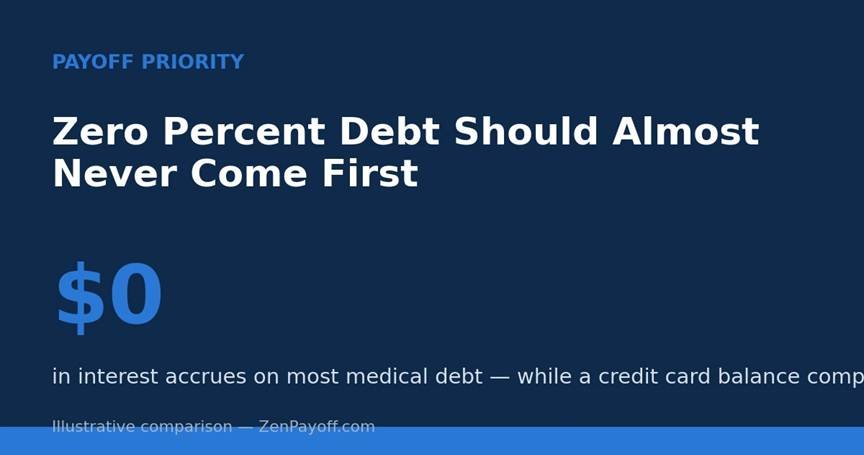
Chart comparing 0% APR medical debt against 22% APR credit card debt to decide payoff priority
Which should you pay first: medical debt or credit card debt?
When people ask me how to pay off their bills quickly while dealing with both medical debt and credit card balances, the usual reaction is to prioritize medical debt since it seems more urgent, serious, and linked to health issues rather than optional spending. However, the figures almost always suggest the opposite because most medical debt carries no interest while credit card debt accumulates aggressively each month it remains unpaid.
Why Medical Debt Is Different From Almost Every Other Debt Type
Personal loans, credit cards, and most other forms of consumer debt are different from medical debt incurred from a hospital or healthcare provider in that the former often has a 0% interest rate, particularly when you are paying the provider directly rather than when the debt has been sent to a collection agency or has been charged to a medical credit card. This one fact alters the entire calculation of how much it costs to pay off the debt: with zero-interest debt there is no extra cost if you take longer to settle it. On the other hand, a credit card balance with an APR of 20% or more increases in value the longer you carry it, no matter how urgently it may feel.
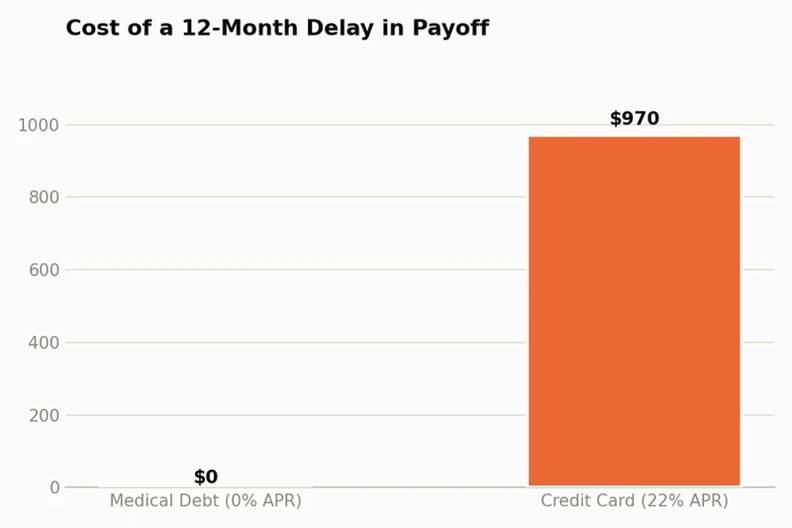
Bar chart comparing interest cost of delaying credit card payoff versus delaying medical debt payoff
The Math: A Side-by-Side Comparison
Suppose you have $3,000 of medical debt on a 0% provider payment plan and also $3,000 of credit card debt charged at 22% APR. With $300 available each month and deciding to divide it equally—$150 for each debt—both types of debt will take around 20 months to pay off, during which time the credit card debt will accumulate approximately $970 in interest. The medical debt, however, incurs exactly $0 in interest no matter how long it takes to pay off.
If you instead choose to pay off the credit card first, make the minimum payments on the medical debt (the interest charge will be the same in either case) and allocate the entire $300 per month towards the card; it will be paid off in around ten months at a total interest cost of about $610 (although interest is charged over the higher initial balance, the shorter period of time results in less total interest). After the credit card has been paid off, the full $300 per month can then be directed towards the medical debt, which will then be settled shortly afterwards. The total interest paid on both debts amounts to $610 rather than $970 with the even-split method—this represents a saving of $360 simply because of the order in which the debts are paid.
The Critical Exception: Examine Interest and Collections Risk
This calculation is based on the assumption that your medical debt actually carries a 0% interest rate and that it won’t be sent to collections. Before you decide to deprioritize any medical debt, make sure that:
- It is the case that payment plans may involve interest; certain hospital systems and the majority of medical credit cards (which are a particular type of product, not the same as a regular hospital payment plan) do charge interest, in some instances at rates comparable to or higher than those of a standard credit card, particularly once the promotional period has ended.
- Missing or failing to make payments could result in collection actions. A medical debt with no interest charge can still be passed on to a collections agency if the payments are not made, which in turn can have an effect on your credit report—thus the term ‘deprioritize’ should refer to making smaller payments, not omitting them.
- For many hospitals, whether or not financial assistance or a reduced settlement is available, charity care or bill-reduction schemes are offered to eligible patients and therefore it’s worth looking into before taking it as settled that the full billed amount will be the figure that applies.
Building the Right Priority Order
- Make sure you check the actual interest rate on each medical debt — don’t assume it is 0% unless you have looked at your particular agreement.
- Arrange all of your debts in order of their true APR, including medical debt, in the same way that you would when using a standard debt avalanche calculator.
- Make the minimum payments on all your debts and use any additional payment capacity on the debt with the highest interest rate first, since that is usually the credit card rather than the medical bill.
- It’s important not to allow a “deprioritized” debt to go without payment—making reduced payments is acceptable but missing payments risks leading to collections and damage to your credit record no matter what the interest rate is.
Modeling Your Own Situation
The figures shown in the comparison are based on specific figures; the actual amount you will save by paying off your debts in the right order will depend on your real balances, interest rates, and the monthly payment you can afford. You can use our free debt payoff calculator to rank your various debts—whether they are medical, credit card, or otherwise—according to their true APR and to see precisely how much you will save on interest by paying them off in the correct order.
What to Do If You Can’t Confirm the Medical Debt’s Interest Rate
If the interest rate is not clearly given on your medical bill or in the payment plan linked to it, you should directly contact the billing department and ask. It is a sensible and typical question, and providers are generally required to say whether or not interest will be applied. In the case where the debt has already been passed on to a collections agency, the terms could have altered — collections agencies often add interest or fees that were not included in the original agreement with the provider — so it’s important to check the current terms before taking for granted that your original 0% rate still stands.
Tracking Multiple Debt Types Together
Medical bills, credit cards, and other kinds of consumer debt are usually not all in the same place; they come from various billers, are paid on different schedules, and have their own rules. There isa premium debt repayment spreadsheet available which deals with different types of debt and ranks all of them according to their true cost so that the order of priority remains clear even when new bills or balances are added.
The mistakes commonly made when comparing medical debt with credit card debt
- Supposing that all medical debt is interest-free without first checking with the actual provider or the terms of the payment plan.
- Focusing solely on paying off medical debt out of a sense of guilt or because it seems urgent, even though the figures clearly indicate that one should pay off interest-bearing debt first.
- Setting medical debt payments to zero rather than agreeing to a smaller, sustainable amount would result in the debt being referred to collections.
- Failing to look into hospital financial assistance schemes, which could reduce the total medical debt you are responsible for before you even reach the point where you consider the payoff order.
What the Data Shows
Research carried out by the Federal Reserve on household debt shows that medical debt differs from revolving credit in the way that most households pay it off, mainly since it is usually free of interest. According to Investopedia’s summary of strategies for prioritising debts, the actual interest cost—rather than the emotional significance or source of the debt—should generally be the factor that determines the order in which debts are paid off when the aim is to minimise the total cost.
What This Looks Like With a Payment Plan Already in Place
Even if you’ve already entered into an arrangement involving a fixed monthly payment for medical bills, you aren’t excluded from using this approach—most providers will let you maintain the agreed minimum amount and instead put any extra disposable income elsewhere. The important point is to contact the billing office if there ever comes a time when you need to alter your minimum payment rather than paying less than agreed upon without first notifying them, since this kind of action usually results in a referral to collections even when the balance is otherwise interest-free.
A Note on Negotiating Medical Bills Directly
Apart from the issue of payoff order, a great many medical bills are more open to negotiation than most consumer debt. Hospitals and healthcare providers frequently agree to lump-sum settlements that are less than the total amount billed, particularly in the case of older balances or when the patient is paying out of pocket for a particular service without insurance. It’s worthwhile to make a phone call before agreeing to a long-term payoff plan for a large medical bill in order to ask about a reduced lump-sum settlement—even a partial reduction makes all the difference to the total amount of debt that you have to prioritize among your accounts.
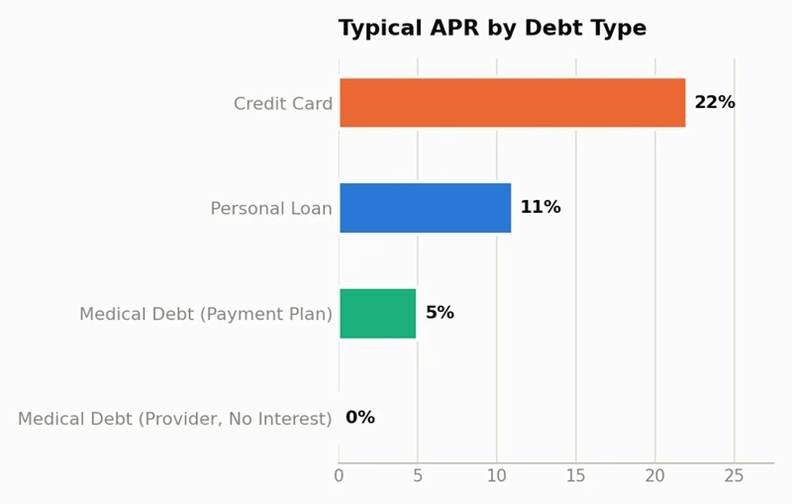
Horizontal bar chart ranking common debt types by typical APR to determine payoff priority
The Bottom Line
It is natural to concentrate on medical debt, but the figures usually make it clear that a medical bill with 0% interest costs nothing extra if you carry it a bit longer, whereas credit card debt compounds throughout the entire period during which it is delayed. The correct course of action is almost always to make timely, manageable payments on interest-free medical debt and at the same time to use any extra payment ability to pay down the balance with the highest APR — on the condition that you have verified the medical debt actually carries no interest and that it is not at risk of being sent to collections.