 ZenPayoff is a 100% free tool. No hidden fees. No forced registration required.
Which of these—taking out a consolidation loan or using the debt avalanche method—will save you more money?
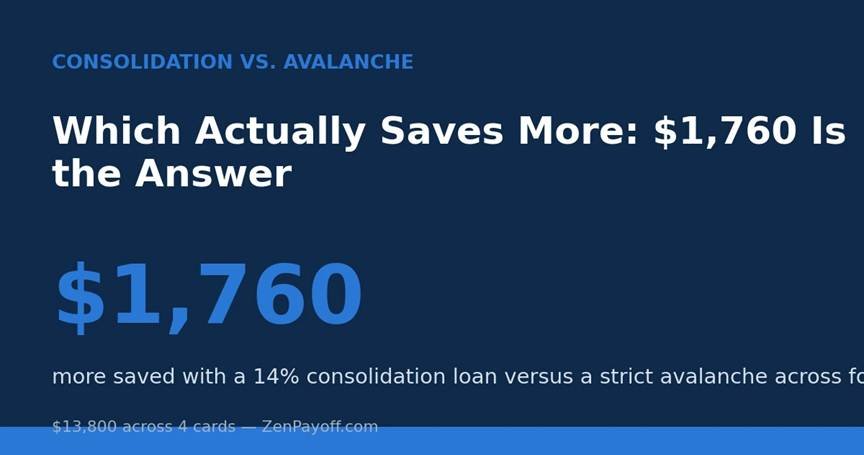
Chart comparing aggregate interest paid between a consolidation loan and a strict debt avalanche plan
Which of the two options, a consolidation loan or the debt avalanche method, will save you more money?
Whenever someone looks into the best methods for consolidating their credit card debt they soon come across a basic yet significant question: is it actually cheaper to obtain a consolidation loan than to pay off the cards you currently have? The truthful answer comes down completely to the interest rate you are able to get, and by comparing both options side by side the choice becomes much clearer than it would by looking only at the headline figures.
Setting Up the Comparison
Consider four credit cards totaling $13,800:
- Store card: $1,200 at 28% APR
- Card D: $2,600 at 24% APR
- Card C: $4,000 at 21% APR
- Card B: $6,000 at 19% APR
If you have $700 a month available for extra payments, making strict use of the debt avalanche method—focusing on the cards with the highest APR—will result in paying off all four cards in about 21 months at a total interest cost of around $3,410.
If you look at a personal consolidation loan that combines all four balances into one at an APR of 14% with the rate fixed for 24 months, the total interest paid on the consolidation loan will be about $1,650, which represents a saving of $1,760 when compared to the approach of only using the avalanche method—even though the consolidation loan takes three months longer to repay.
Bar chart comparing total interest incurred under debt avalanche versus a consolidation loan
Why the Consolidation Loan Wins Here
The figures make it obvious when you look at them: each of the four original cards has an APR that is higher than the 14% offered by the consolidation loan. By combining them into one loan with a lower rate, each dollar of the remaining balance starts to earn interest at a lower rate than it was earning before, no matter in what order you would have paid off the cards. While the avalanche method is designed to optimize the order in which you pay off high-interest debts, consolidation actually reduces the interest rate itself. If a significantly lower rate is available, consolidation can beat even a perfectly carried out avalanche.
When Debt Avalanche Wins Instead
The situation is different when the interest rate on the consolidation loan is not significantly lower than the average rate on your current credit cards or when the arrangement fees reduce the amount of money you save. In the case where the best interest rate you can get is 19–20% rather than 14%—a situation that often occurs with people who have fair rather than excellent credit—the total cost of the loan after taking into account the fees can be equal to or even greater than that of a well-implemented avalanche strategy on the first cards. Since a 3-5% arrangement fee, which is typical on a great many consolidation loans, has to be included in the loan’s overall cost before it can be compared with the interest-only avalanche figure.
The Checklist Before Consolidating
- Make sure you get the actual APR quoted to you, not the advertised “as low as” rate, since your true APR will vary according to your credit profile.
- Be sure to include the origination fee when calculating the total cost of the loan before comparing it to your estimated avalanche interest.
- Make sure that the term of the loan is not longer than it needs to be, since even at a lower interest rate increasing the term from 24 to 60 months can result in a higher total amount of interest being paid.
- Make sure that the loan is actually a fixed-rate one, since some of the “consolidation” products marketed to subprime borrowers have variable rates which may go up.
- Do not feel the need to recharge the consolidated cards. Consolidation only succeeds if the spending habits which caused the balances to build up also change—otherwise you will end up with balances on both the consolidation loan and the new card.
Running Your Own Numbers
The $1,760 figure mentioned above applies to a 14% consolidation rate and a blended APR spread of 19-28% on the existing cards. The actual rate, balances and fees you have will affect the comparison. By usingour free debt payoff calculator you will be able to examine both a strict avalanche plan and a consolidation scenario based on your own figures and find out which one saves more before you sign any loan documents.
A Third Option: Balance Transfer Cards
For small total balances a 0% APR balance transfer card may in some cases be better than the two options mentioned above, since a genuine 0% introductory rate (usually lasting 12 to 21 months and often involving a 3% to 5% transfer fee) can be cheaper than even a good consolidation loan rate—provided you can realistically pay off the balance before the promotional period finishes. This approach is most suitable for balances of about $10,000 to $12,000 where it is plausible to pay the entire amount off within the promotional period; for larger balances which would take several years to pay off, a fixed-rate consolidation loan is generally more reliable because it avoids the risk of the rate rising after the promotional period ends.
What to Do If You’re Denied for Consolidation
It’s usual for people with a poor credit score or a high existing debt-to-income ratio to not be able to secure a consolidation loan at a rate that is better than the one they currently pay on their credit cards. In that case, sticking to an effectively carried out avalanche method for your existing cards is a fully legitimate approach and one that you should monitor carefully. You can useour credit card debt tracker to have all four (or as many as you have) balances, interest rates, and minimum payments kept in one place as you pay them off according to the avalanche method.
Common Mistakes When Comparing These Options
- To compare the monthly payment of the loan with the minimum payments required by the cards, rather than comparing the total interest paid——even a lower monthly payment on a longer-term loan can result in a higher total cost.
- When calculating the effective rate of the loan, the origination fee should be ignored.
- It is possible that the reduced rate advertised will apply to you even if you do not obtain a quote that has been tailored to your real credit profile.
- Closing original credit card accounts immediately after consolidating, which can affect your credit utilization ratio and average account age — consider keeping accounts open with a zero balance instead, unless annual fees make that impracticAccording to Investopedia’s guide on debt consolidation, a consolidation loan only offers a sound financial outcome when the new interest rate is meaningfully lower than the weighted-average rate of the debts being consolidated—as shown in the comparison above. Recent years have seen the average credit card APR, as indicated by data from the Federal Reserve on consumer credit, stay well above the rates typically charged on personal loans, and this helps to explain why consolidation can be beneficial for eligible borrowers. Yet individual interest rate offers vary considerably depending on a person’s credit profile. offers differ greatly by credit profilIn simple terms, the outcome of the decision can be summarized like this: obtain a genuine consolidation quote first, add on any associated fees to that quote, and then compare the total amount with the interest rate you expect to pay on your current debt. If the consolidated loan’s overall cost is lower, then it is the better option—indeed, it generally also makes your finances easier by replacing four or more monthly payments and due dates with just one, a benefit that has practical value in itself beyond the simple interest calculation. However, if the consolidation quote does not offer a substantial advantage, or if you’re not sure that you’ll be able to avoid rebuilding up balances on your credit cards after consolidation, it is safer and just as reasonable to stick with a well-disciplined avalanche approach on your existing accounts. remains the safer, equally valid choice.
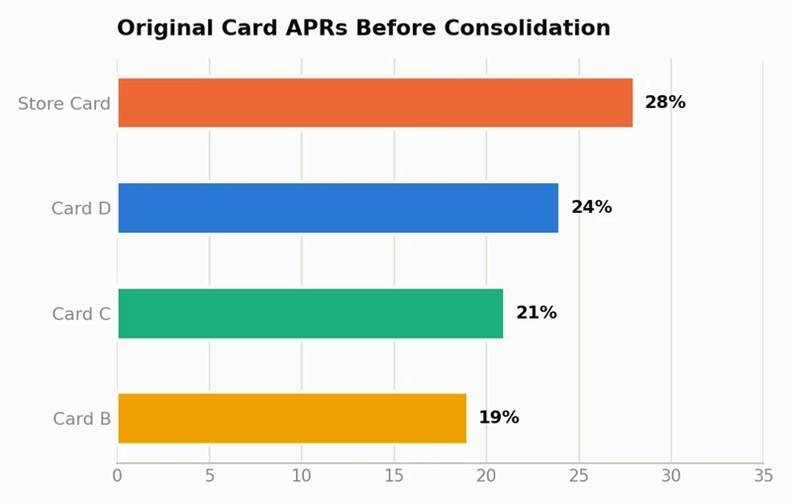
Horizontal bar chart showing four original credit card APRs before consolidation
The Bottom Line
There is no one-size-fits-all solution as to whether consolidation or the avalanche method is more cost effective — it all comes down to the rate you can actually obtain. If a substantially lower consolidation rate is on offer, it can beat even a well carried out avalanche approach, in some cases by a large margin. On the other hand, if this is not the case, it is better to stick with the cards you currently have and pay them off in strict avalanche order. The only way to determine which method applies to your particular situation is to work through both options using your actual figures rather than supposing that one technique is generally better.