 ZenPayoff is a 100% free tool. No hidden fees. No forced registration required.
 What happens when you make only the minimum payment on your credit card each month.
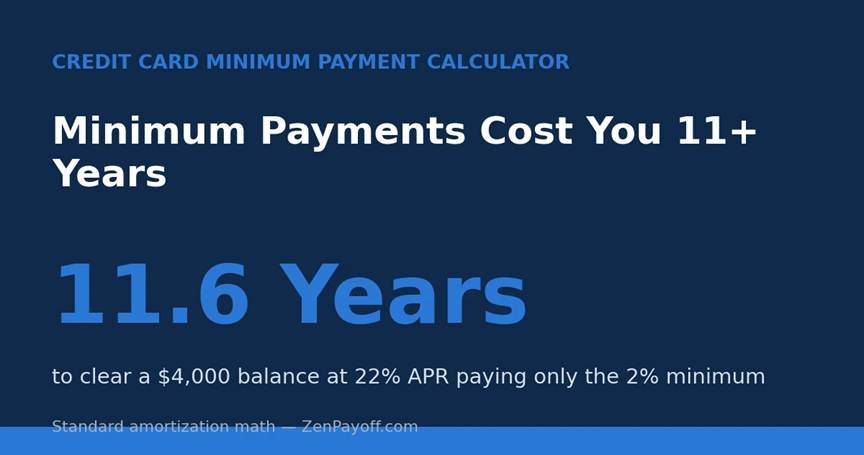
Chart showing it takes over 11 years to pay off a $4,000 credit card balance using only minimum payments
Let’s consider the figures when you make only the minimum payment on your credit card.
A typical credit card minimum payment calculator tells you how much to pay this month but doesn’t show the real cost of making only minimum payments over time. I’ve done this calculation for many ZenPayoff readers, and the results always surprise them. For example, with a $4,000 balance and a 22 percent interest rate, paying 2 percent monthly will take 11 years and 7 months to pay off the debt. By then, the total interest paid will exceed the original amount spent.
Credit card companies usually set your minimum payment as a fixed amount (often $25 to $35) or a percentage of your balance (usually 1 to 3%), plus any interest and fees for the month. There are two main risks with this method. As your balance goes down, so does your minimum payment. While that might seem helpful, it can make paying off your debt take much longer.
- Interest is calculated daily and added to your bill each month. The company uses your annual percentage rate and average daily balance to figure this out. That’s why a $50 payment often just covers the interest that built up before you paid.
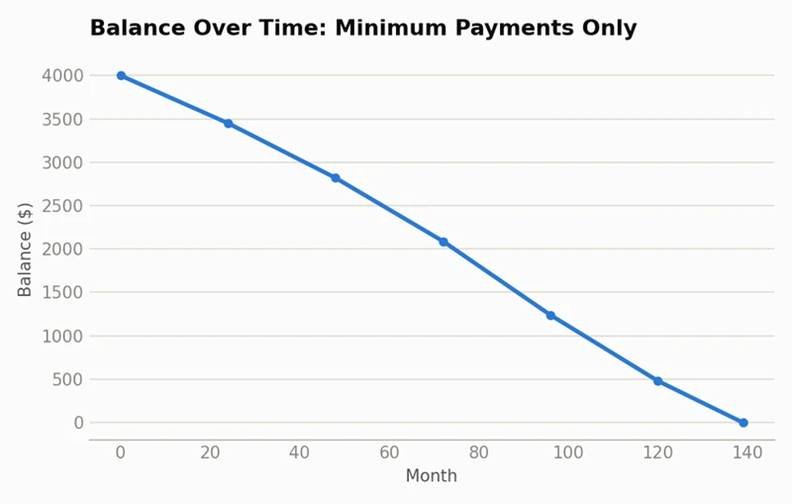
Line chart showing a credit card balance declining very slowly over 139 months under minimum payments only
The Math: A $4,000 Balance at 22% APR
Let’s walk through this example step by step, just as I would with a client:
- Starting balance: $4,000
- APR: 22% (roughly the national average for accounts carrying a balance)
- Minimum payment: 2% of balance or $35, whichever is greater
- In the first month the minimum payment is $80, roughly $73 being interest and only $7 going towards reducing the balance. (Irby & Tipsword, 2025)
As your balance goes down, less of your payment goes to interest, but it would still take 139 months, almost 12 years, to pay off the debt. You’d pay about $5,340 in interest, more than the original $4,000 balance. If you paid a fixed $150 each month instead, you’d be debt-free in about 32 months and pay only $1,310 in interest. That’s over $4,000 more that making only minimum payments quietly hands over to the credit card company.
Why the Percentage Trap Is So Dangerous
The real problem is that minimum payments calculated as a certain percentage are intended to benefit the card company, not you; as your balance decreases, the amount you have to pay also becomes smaller, so the progress you notice each month is not as real as it appears. Although a lot of people believe that paying the minimum is safe and responsible, it in fact constitutes the slowest and most expensive method of paying off debt. If you instead choose to make a fixed dollar amount payment each month and keep to it—even if you start by paying the minimum in the first month and continue to do so rather than reducing the payment—you will end up saving a lot of money over time.
- If you receive any additional money, go ahead and use it right away to reduce your balance since it is generally advisable to allocate unexpected cash to high-interest debt.
- Before settling on a plan, make sure you check your actual figures. Instead of guessing, use our free debt payoff calculator by putting in your balance, APR, and monthly payment to find out when you’ll be free from debt and how much interest you’ll end up paying.
What This Looks Like With Multiple Cards
The vast majority of people who have credit card debt hold more than one such card, which makes it even more difficult to keep up with all the minimum payments. (How Credit Card Issuers Calculate Minimum Payments, 2023) The minimum payment due on each card can vary independently of the others, and it’s easy to forget which balance is costing you the most. My credit card debt tracker brings together all your balances, interest rates, and minimum payments in a single place so that you won’t have to go through various statements or log into several accounts. It’s tempting to pay only the minimum since that figure is straightforward to find on your statement. However, that is precisely why this system is so advantageous for the card companies. Although the overall cost accumulates over a period of more than ten years, paying the minimum can give the impression that the problem has been solved. As I’ve found in my experience, individuals only come to realize the full extent of the situation when they see how many years it will take to pay off the debt. At that point, making a small monthly payment becomes equivalent to paying for almost the entire cost of your child’s education.
Common Mistakes to Avoid
- If you make only the minimum payment, your account will remain open and in good standing, but the card company will earn more interest rather than assisting you in paying off your debt more quickly. The fact that the minimum payment is low doesn’t indicate that you have extra money available in your budget; it only means that it will take over ten years to pay off the balance. (The Minimum-Payment Trap: How Long Credit-Card Debt Really Takes to Pay Off, 2026)
- A number of people don’t start making larger payments until it becomes more convenient to do so. Yet if you only pay the minimum amount each month your total interest will keep on rising because the balance compounds on a daily basis.
- Keep in mind that your interest rate may change; if your card has a variable rate linked to the prime rate, your APR could increase or decrease, which in turn will affect the time it takes you to pay off your debt even if the amount of your payment remains unchanged.
What the Data Confirms
The Federal Reserve’s G.19 consumer credit report shows that average credit card balances in households in America are still high. The latest State of Credit Cards report from Experian states that the average debt per cardholder exceeds $6,500; it is therefore quite typical for the starting balance of $4,000 referred to in the previous example. (Consumer Credit – G.19, 2026)
Comparing Payoff Speeds at Different Fixed Payments
If you want to make a payment that is more than the minimum, you should first examine the value given by each extra $25 or $50. For example, with a balance of $4,000 and an APR of 22%:
- $80/month (roughly the starting minimum): ~139 months, ~$5,340 in interest
- $120/month: ~47 months, ~$1,780 in interest
- $150/month: ~32 months, ~$1,310 in interest
- $200/month: ~23 months, ~$960 in interest (team, 2026)
If you raise your monthly payment from the minimum level to just $120, you’ll be able to pay off your debt in about one-third of the time and will end up saving over $3,500 on interest. This is the reason why it’s worth taking five minutes to use a debt calculator before relying on the figure given on your statement; the more you pay towards your balance, even if the extra amount is only a small one, the less interest you’ll have to pay and the faster you’ll be able to get rid of your debt.
When Minimum Payments Are the Only Option
It’s all right to make only the minimum payment in certain situations—for example, if you’ve lost your job, are facing a medical emergency, or experience a temporary drop in income. This allows your account to remain in good standing as you recover. The important thing is to understand your own circumstances and not feel guilty about it. You should bear in mind that it will take over ten years to pay off the full balance if you only make the minimum payments, so whenever you can, try to pay more. In that way, you’ll not be surprised later on when your balance hasn’t changed much.
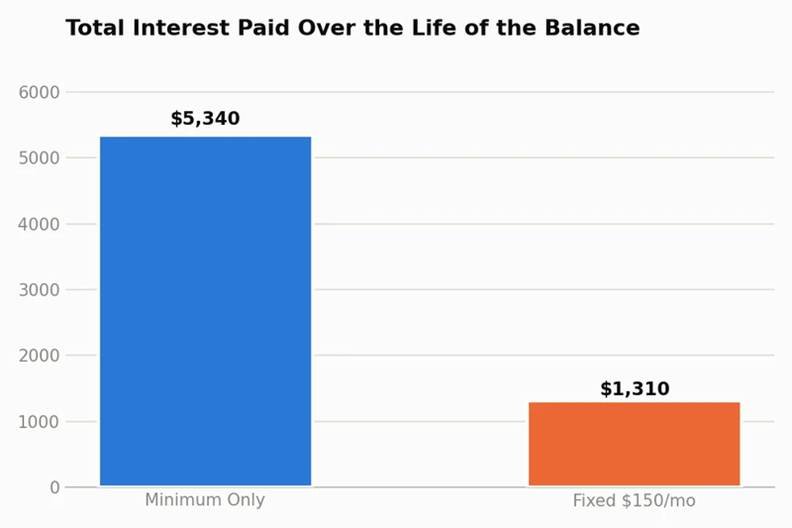
Bar chart comparing total interest charged between minimum payments and a fixed $150 monthly payment
The Bottom Line
A minimum payment is not a true repayment plan since it merely allows the card company to earn more interest; even if your balance is small and the interest rate is typical it can take more than ten years to pay off and the total amount of interest you end up paying will be greater than the original amount you spent. Regardless of how many cards you have, the only way to find out how much you could save by paying more each month is to work out the figures yourself.