 ZenPayoff is a 100% free tool. No hidden fees. No forced registration required.
 Debt Repayment Strategies The “Snowball Method” vs. the “Avalanche Method”: A Brilliant Mathematical Trick for Paying Off Debt Quickly
Most people who read about the snowball and avalanche methods are dealing with the same issue: it’s time to stop guessing. You have three or four debts to pay off, a limited amount of extra money each month, and a nagging feeling that you’re putting your money in the wrong place.
The great news is that the math behind both strategies once you see it laid out with real numbers makes the right choice for your situation clear in about ten minutes.
The uncomfortable news is that the difference between the two methods is often smaller than people expect and much smaller than the difference between having a plan and having no plan at all. Now, let’s prove and verify both statements together.
Understanding Debt Reduction Strategies
Every debt repayment plan in the world is built on these same two key components, which we’ll look at now:
• The minimum payment on each account, always, without exception.
• A single additional amount that you allocate each month to one specific target account.
Yes, that’s all there is to it. The snowball and avalanche methods aren’t two different systems—they’re the same system with different answers to a single question: Which account gets the extra amount first?
The decisive mechanism the part that actually gives the snowball method its name is that your total monthly payment never shrinks. When one account reaches zero, its minimum payment doesn’t revert to your budget it’s added to the assault on the next target account. This snowballing effect is what turns a five-year repayment plan into one that lasts only two years.
How does the snowball method actually work?
Here’s how: Ignore interest rates entirely and rank your debts from the one with the smallest balance to the one with the largest.
Pay the minimum payment on all accounts, and apply any additional payments in full to the account with the smallest balance until it is paid off. Once that account is paid off, apply the savings to the account with the next smallest balance.
There’s a behavioral psychology logic at work here: you quickly pay off one account, feel a sense of accomplishment, and then move on to the next one. That’s the secret to success.
What exactly is the “avalanche method”?
Debts are ranked by annual interest rate from highest to lowest, and then the balance is completely ignored and handled as follows:
The minimum payment due on each account is made, and any amount exceeding that is allocated to the account with the highest annual interest rate until it is paid off in full; after full repayment, payments move on to the account with the second-highest annual interest rate.
The logic here is based on math. Since interest represents a burden, the goal is to focus first on the account that incurs the highest cost. It is mathematically certain that the “avalanche” method minimizes the total cost of interest as much as possible; this is not merely an opinion, but a property clearly inherent in the structure of compound interest.
So why doesn’t everyone adopt the “avalanche method”? That’s because “mathematically optimal” and “practically feasible” are two entirely separate matters.
The Actual Calculation: A Side-by-Side Comparison
The definition can be explained simply. Now, let’s do the calculation using actual numbers.
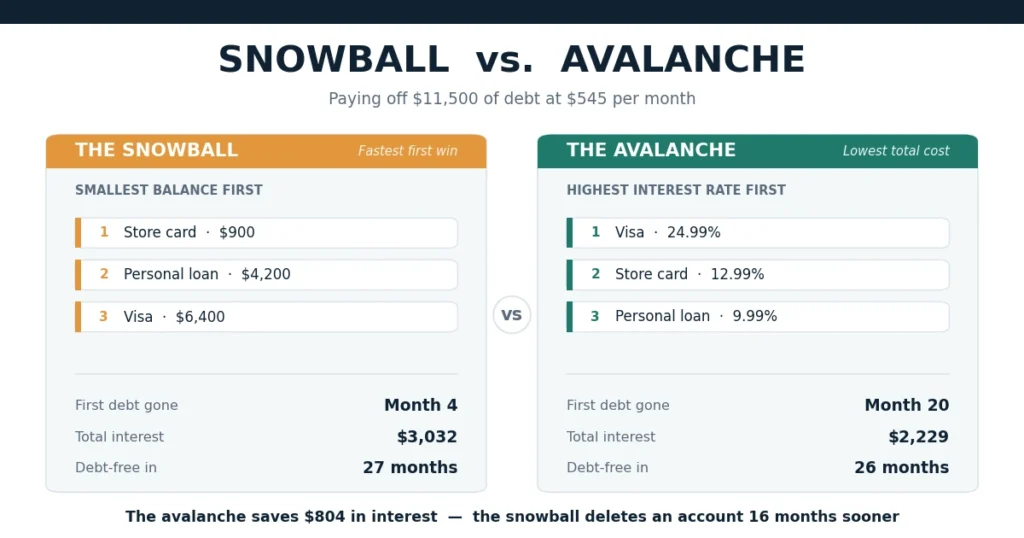
Suppose there is a fictional family that has a total of $11,500 spread across three accounts. The total minimum monthly payment is $295, but this family has managed to set aside an additional $250 from their budget. This means they will continue to pay $545 per month until the balances in all accounts reach zero.
| Account | Balance | APR | Minimum |
| Store card | $900 | 12.99% | $25 |
| Visa | $6,400 | 24.99% | $160 |
| Personal loan | $4,200 | 9.99% | $110 |
Please note a key feature of this situation. A lower balance does not necessarily mean a higher interest rate. It is precisely on this point that the two methods differ.
“Snowball” method order: store card ← personal loan ← Visa card
“Avalanche” method order: Visa card ← store card ← personal loan
Here’s an explanation of how the two strategies actually work:
| Debt Snowball | Debt Avalanche | |
| First account eliminated | Month 4 | Month 20 |
| Total interest paid | $3,032 | $2,229 |
| Debt-free in | 27 months | 26 months |
The “avalanche” method is the best. That’s because it saves $804 in interest and saves one month of time.
But please take a close look at the top row. No one includes this row in the comparison table.
With the “snowball method,” this family pays off all accounts to zero in the fourth month. In contrast, with the “avalanche method,” the family must be patient for 20 months as they watch the $6,400 balance gradually decrease until every account is completely paid off.
The amount is the same. The discipline is the same. But the psychological experience is completely different.

The amount that exceeds the sum of the two amounts
And here comes the really important comparison.
If that family didn’t pay any additional amount at all but simply paid the minimum payment of $295 they would remain in debt for 64 months and pay $7,369 in interest.
Please keep this number in mind:
• If you choose the “avalanche method” instead of the “snowball method,” you’ll save $804.
• If you don’t just pay the minimum payments but choose either of these two methods, you’ll save over $4,300 and can shorten the repayment period by three years.
The additional $250 monthly payment has about five times the impact compared to the “Prioritization” strategy. If there’s one thing worth remembering from this article, it’s this: Ignoring the payment amount while focusing solely on improving the repayment order is like polishing the rims of a car without an engine.
Whichever method you choose, crunch the numbers first! Using our free debt repayment calculator, you can enter your current balance and effective interest rate in less than 5 minutes.
How to Pay Off Credit Card Debt Quickly Using the “Avalanche Method”
If you’d rather pay off $804 than feel a sense of early accomplishment, follow these practical steps.
Step 1 : Make a list. Write down all your debts, excluding your mortgage, divided into three columns: “Balance,” “Annual Percentage Rate (APR),” and “Minimum Payment.” Verify the interest rate from your actual statement, not from memory, because credit card users tend to underestimate the actual interest rate by a few points.
Step 2 : Determine your actual surplus. Track your expenses for 30 days to determine your realistic surplus. Don’t focus on an ideal number, but rather on the amount you can maintain even during tough weeks.
Step 3 : Rank your debts from highest to lowest interest rate. The balance amount doesn’t matter here. A $400 balance with a 29.99% interest rate takes priority over a $9,000 loan with a 6% interest rate.
Step 4 : Automate your minimum payments. Set up automatic payments on the due date for each account. Missing just one payment can result in late fees of nearly 30%, which could wipe out the progress you’ve made over several months.
Step 5 : Transfer any surplus to the highest-priority account. Make the transfer manually the day after you receive your paycheck, before that money gets spent on daily living expenses.
Step 6 : Roll over the balance. Never let up. Once the top-priority account is paid off in full, its minimum payment is added to the surplus, and the total amount is allocated to paying off the second-priority account. The total monthly payment will remain fixed at $545 until the last account is paid off in full.
Step 7 : Aim for the same interest rate. Although this step is practically free, most people overlook it. According to a 2026 survey by LendingTree, 84% of cardholders who asked their issuer for a lower interest rate actually received one, with an average reduction of 6.3 percentage points. However, only 23% of them had originally asked for a reduction. A single phone call may be more effective than months of adjustments and reviews.
When Does the “Snowball” Method Become the Best Way to Pay Off Debt?
I remember the moment I made my final car loan payment three years ago. The instant the balance hit zero, I was overcome by a feeling as if a heavy burden had been lifted from my shoulders. It was a feeling I had never experienced before in my life, not even when I made any financial gains. But the surprise was that the following month, I realized I had started without even thinking about it to automatically save the amount I had been setting aside for the loan payment, as if the habit had turned into an instinct. And that’s exactly what I’ve read time and time again in letters from readers. Most of them don’t remember the exact amount of interest they saved through the “snowball method,” but they do remember that small psychological victory they experience every time they cross off one small debt after another from their list. This is precisely where the “snowball method” becomes the best option especially when this battle is more psychological than mathematical, and when the need for motivation to stay on this path is at its strongest.
A successful plan looks promising on paper. But even on paper, not everyone manages to carry out their plans successfully.
A research team from Northwestern University’s Kellogg School of Management analyzed real customer data from a debt settlement company and found that consumers who paid off small debts first were more likely to pay off their debts in full, even if they had to pay more in interest. Subsequently, a study published in the Journal of Consumer Research revealed the mechanism behind this phenomenon. The study suggests that the motivation has less to do with the amount of interest avoided and more to do with the tangible reduction in the balance of a specific account.
Your brain processes the idea that “this account has been paid off in full” better than the idea that “$804 has been saved over 27 months.”
Choose the “snowball strategy” in the following situations:
• If you’ve abandoned a repayment plan in the past.
• If you have one or two balances under $1,000 that you can pay off in full this quarter.
• If the number of open accounts is a major source of stress for you.
• If the difference in interest rates is very small (if the interest rates for all accounts fall within a range of about 5 basis points).
In the following cases, please choose the “avalanche strategy”:
• If you have one account with a significantly different interest rate for example, a credit card with a 27% interest rate and a loan with an 8% interest rate at the same time.
• If you regularly review your financial situation and don’t need external motivation.
• If the difference in interest rates is large enough that the amount you’ll save could reach four figures.
A hybrid approach that is often overlooked in most articles. You don’t have to choose just one method and stick to it.
The “modified avalanche method” works like this: First, you pay off the smallest debts that can be paid off within 60 days, then you systematically tackle the remaining debts in order of their interest rates.
For my family, for example, this meant paying off the $900 store card first (in the fourth month—a psychological victory), then applying the pure snowball method to the Visa card. This allows you to gain initial psychological momentum while saving as much in interest charges as possible. For most people managing three or more accounts, this approach is the most practical solution.
Whichever path you choose, your plan should include measurable metrics. Tracking tools are always more effective than willpower alone. If you want to manage your revolving accounts automatically, you can download an excellent debt repayment spreadsheet.
Let’s take a look at the latest interest rates.
To understand the significance of this critical issue: According to the U.S. Federal Reserve Board’s (FRB) G.19 report on consumer credit, the average annual interest rate on credit card balances in the second half of 2026 was 22.15 percent.
At this interest rate, you’ll earn about $92 in interest each month on a balance of $5,000 before you pay back even a single dollar of the principal. The most expensive thing here is time, not the method you choose.
Final Conclusion: The “Snowball” Method vs. the “Crash” Method
The “Crash” method is cheaper. On the other hand, the probability of completing the project using the “Snowball” method is higher. Furthermore, both methods are far better than the option of “doing the bare minimum and leaving the rest to chance.”
When the difference in profit margins is significant, the “crash” method should be adopted. If, based on past results, it is determined that results must be achieved within the first 90 days, the “snowball” method should be adopted. And if you’re willing to openly acknowledge that both methods are necessary, the hybrid method should be adopted.
The debate over the “snowball method” versus the “crash method” has sparked numerous discussions online, but in reality, the difference between them may amount to only a few hundred dollars. Choose the method that suits you today, set up a standing order for the minimum payment tonight, and starting tomorrow, allocate every extra dollar to investing. The strategy you actually implement is the path that will lead to bringing your balance back to zero.