 ZenPayoff is a 100% free tool. No hidden fees. No forced registration required.
The Psychology of the Debt Snowball: Why Minor Victories Rewire Your Financial Brain

Infographic showing three small debts cleared within 5 months, building momentum toward a larger payoff
The Psychology of the Debt Snowball: Why Minor Victories Rewire Your Financial Brain
Whenever you enter a debt snowball calculation into a snowball calculator, you’ll always get the same answer—the snowball method almost never results in the lowest total interest paid, even though it is still one of the most widely recommended ways to pay off debt. The reason for this lies not in mathematics but in psychology. The difference between a debt repayment plan that actually gets finished and one that slows down and stays unresolved after about six months is precisely this understanding.
The Behavioral Science Behind “Minor Victories”
Research into the subject of goal pursuit has on many occasions demonstrated that showing progress indicators which are visible and frequently displayed has a greater effect on increasing persistence than having a single, far-off goal. This phenomenon is known as the “minor victories” effect; it occurs when a huge and intimidating objective is broken down into smaller, reachable milestones, since each of these milestones appears to be attainable and thus encourages motivation to achieve the next one. Although a total debt of $22,000 may seem overwhelming, a balance of $600 which can be paid off in six weeks does not.
The small-wins psychology principle is actually put into practice in the area of personal finance by listing the debts from the one with the smallest balance to the one with the largest balance, ignoring the interest rate altogether, and then directing each extra dollar towards the debt which has the smallest balance first.
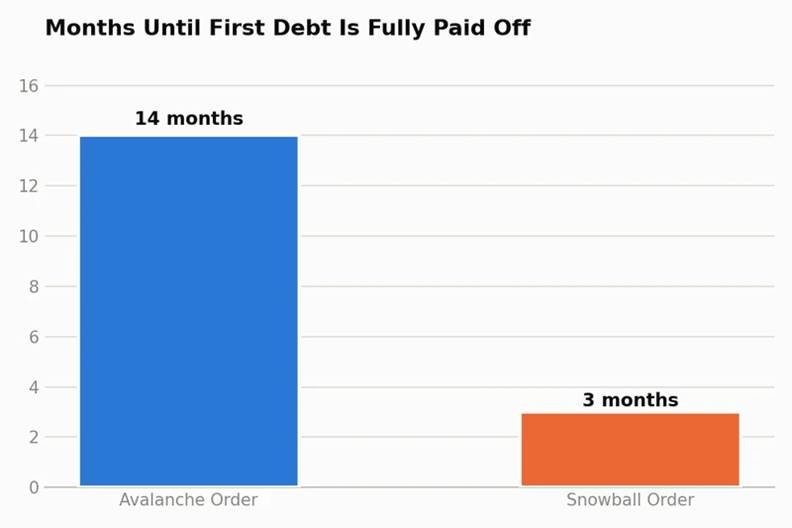
Bar chart comparing months until the first debt is fully paid off under snowball versus avalanche ordering
The Math: A 4-Debt, $14,300 Case Study
Consider four debts that are common among ZenPayoff readers carrying multiple balances:
- Medical bill: $600 at 0% APR
- Store card: $1,400 at 27% APR
- Credit card: $4,300 at 21% APR
- Personal loan: $8,000 at 10% APR
With $500/month available for debt payments beyond minimums, here’s how the two methods diverge:
- If the debts are paid off in the order of highest APR—that is, the store card first, then the credit card, then the medical bill, and last of all the loan—it will be about 14 months before the first debt is settled. This is since the balance on the store card together with the higher balance on the credit card causes it to take that long to pay them off.
- If the debts are arranged in order of the amount owed with the smallest first—that is, the medical bill, followed by the store card, then the credit card, and last of all the loan—the $600 medical bill is paid off after approximately three months, the store card is settled by the eighth month and the credit card by the sixteenth month.
The avalanche method results in lower total interest—about $1,890 rather than $2,240 with the snowball method—thus saving approximately $350 over the whole payoff period. Yet, the snowball method pays off its first account after three months rather than 14 months and manages to pay off a second one by the eighth month. This kind of advantage is what the small-wins effect is aimed at: obtaining four motivational boosts instead of having to wait the entire time, in return for a small extra interest cost of about $350.
Why 14 Months Without a Win Is a Real Risk
On examining payoff plans I discover that the majority of them fail between four and fourteen months—not as a result of any change in the maths, but because the initial motivation vanishes. Once there is no visible milestone to take its place, other financial worries or the temptation to loosen the budget come back. Since any plan requires more than a year of continuous effort before it produces its first complete result, it places a great strain on one’s willpower, regardless of how sound the maths is.
Building Your Own Snowball Order
- Prepare a list of all the debts together with their exact balances and omit the interest rate in this instance.
- Sort smallest to largest.
- With the only exception of the smallest ones, you should make the minimum payments on all the rest.
- Continue to allocate additional money towards the smallest balance until that balance has been eliminated.
- Add the whole payment, both the minimum and any extra, to the next smallest debt.
Since each payment increases your total ‘extra payment’, the following one takes less time than the previous one. That is the reason why this method is known as the ‘snowball’ effect. Rather than calculating it yourself, you can use our free debt payoff calculator, which displays your debts in snowball order and shows precisely when each one will be paid off. The Extra Interest
The snowball method will probably appearThe snowball method looks psychologically reasonable if you’ve had difficulty in maintaining a payoff plan or if you have a large number of debts so that it is realistic to have to wait twelve months or more before achieving the first win. On the other hand, if the debt with the highest balance also has the highest interest rate and you have a good record of sticking to financial plans, the lower total interest cost of the avalanche method might make it worthwhile to give up the early psychological benefit.
The small-wins effect only occurs when you keep notice of and record each milestone; if you pay off a debt without tracking it or celebrating it, you miss out on the motivational advantage that the research points to. A number of ZenPayoff readers have found that seeing their debt payoff sequence worked out in advance, with each milestone clearly marked, has a greater effect on boosting motivation than simply looking at a single account statement that shows a decreasing balance. You are able to download a premium debt payoff spreadsheet which lists the complete snowball order with each payoff date acting as a milestone.
What the Research and Data Support
In reality the anecdotal method referred to exists, and Investopedia’s comparison of the debt snowball and avalanche methods notes that behavioural studies concerning debt repayment have found snowball-type, small-balance-first methods to be associated with a greater likelihood of getting rid of all one’s debt than strict interest-rate-first approaches—even though the latter is the mathematically better option. Furthermore, data from the Federal Reserve on household debt shows that it is the level of consistent repayment behaviour, not the method chosen, that is best at predicting whether or not a household will reduce its total debt over time.
Common Mistakes That Undermine the Snowball Effect
- Actually, ignoring the interest rate when sorting is not genuine; the combination of snowball and avalanche logic (sorting by “balance, but also in a way by rate”) undermines both the psychological advantage and the mathematical benefit.
- If the amount that has been freed is not carried forward into the next payment then the compounding motivation effect will only operate if each payment is clearly causing the following one to increase. However, if the freed payment is included in general spending the snowball effect ceases to function.
- There is a good reason to choose the snowball method when the extra interest cost is genuinely impossible to afford. If the difference in interest rates between your smallest and largest debts is great, the extra cost involved in using the snowball approach can be significant enough to make the psychological sacrifice worthwhile. It is necessary to know this figure before making a decision.
What Happens After the Last Debt Is Cleared
The small-wins effect doesn’t stop once your debts have been paid. The same psychological process which makes the snowball method effective for paying off debt also applies to other actions such as setting up an emergency fund, saving towards a particular goal, or investing for retirement. A large number of people who complete a snowball plan claim that the habit of ‘clearing one aim and then putting the money that has been freed into the next goal’ becomes a permanent financial habit and lasts well beyond the time when the original debt has been settled. The approach that was successful in getting rid of debt is just as effective when it comes to building up wealth afterwards.
A Realistic Example of the Full Timeline
If we go back to the example involving $14,300 and four debts, then by the third month the medical bill has disappeared. By the eighth month the balance on the store card is paid off. At the sixteenth month the credit card debt is cleared, so that only the $8,000 personal loan remains. The personal loan then gets the full total of the payments from all three of the previous debts together with the first minimum payment, which speeds up its repayment considerably compared to if it had been handled by itself. The entire scheme is completed by the twenty-sixth month, that is about two years and two months after it starts, and includes four clear milestones rather than one long, featureless process.
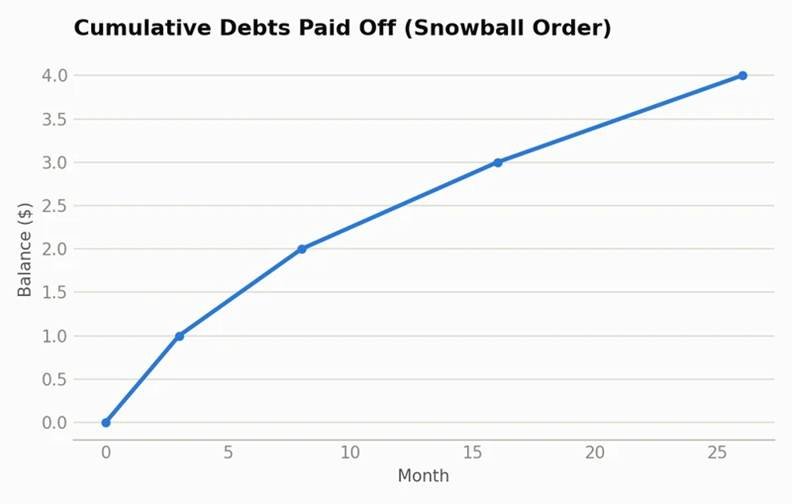
Line chart showing the cumulative number of debts paid off over time under the snowball method
The Bottom Line
The debt snowball method isn’t likely to win out when you look at the maths, and that’s not necessary. Its main advantage is behavioural in that it takes a far-off and daunting aim and replaces it with a series of achievable targets which in turn keep people’s motivation — and thus their willingness to make repayments — alive. For a lot of people, the fact that the total interest is only $350 more is a small cost to pay for a method which is actually much more likely to be completed.