 ZenPayoff is a 100% free tool. No hidden fees. No forced registration required.
 The Hybrid Debt Payoff Strategy: Combining Emotional Wins with Mathematical Savings

Infographic showing the hybrid debt reduction strategy saving $612 in interest compared to a pure snowball payoff
The Hybrid Debt Payoff Strategy: Combining Emotional Wins with Mathematical Savings
If you’ve ever wanted to know how to pay off your debt, you’ve most likely come across the ongoing debate as to whether you should go for the snowball method or the debt avalanche method. The snowball method consists in paying off the debt which has the lowest balance first because this provides a psychological advantage; should you instead decide to target the one with the highest interest rate and devote as much of your money as possible to it? Since I’ve assisted thousands of ZenPayoff users in drawing up their own debt repayment plans, I can clearly say that the best strategy is very seldom just one or the other; a combined approach—that is, first clearing the debt with the smallest balance and then switching to focusing on the one with the highest APR—performs better than a strict snowball method while at the same time giving the early motivational push that prevents people from giving up by the third month.
A quick review of Snowball versus Avalanche
It would be helpful, before you do so, to clearly distinguish between the two standard methods when constructing the hybrid model.
- If you are using the debt snowball method, you ought to start by making a list of your debts with the one having the lowest balance first and the one with the highest balance last, without considering the interest rates; you have to make minimum payments on all of the debts except for that one which has the lowest balance, and then for each extra dollar you earn, you should apply it to the debt with the smallest balance, and once that debt has been paid off, you should add that payment to the next smallest balance.
- When using the debt debt avalanche strategy, list your debts in order from the one with the highest APR to the one with the lowest, regardless of how large or small the balance is. You should always allocate each additional dollar to the debt that has the highest rate, since that is the most expensive debt to carry when viewed from a mathematical standpoint.
The snowball method is advantageous in terms of building up behavioural momentum since studies carried out by personal finance experts (as well as those referred to in the literature on behavioural economics) show that if progress is clearly visible and occurs rapidly, you are more likely to keep committed to your plan. On the other hand, the avalanche strategy is more favourable from a purely mathematical point of view as it lowers the total amount of interest paid throughout the period. The blended approach seeks to combine both of these benefits.
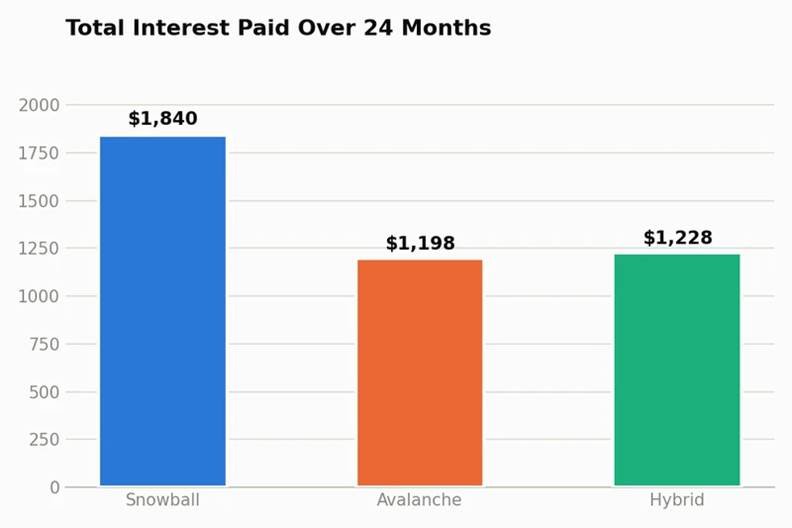
Bar chart comparing total interest owed under snowball, avalanche, and hybrid debt reduction strategies
The Math: A $9,200 Case Study
Imagine three balances that are fairly typical for a ZenPayoff reader:
- The balance on the credit card is $1,100 and the annual percentage rate is 26.9 per cent.
- The annual percentage rate is 22.4 per cent and the credit card balance is $4,600.
- A personal loan with an annual interest rate of 11.5% for a sum of $3,500.
Imagine that you are able to pay off your debt each month with a total of $450 (this figure covers both the minimum payments and one extra payment). If you use the pure snowball method, you should begin with the $1,100 store card, pay it off in roughly two months and then proceed to the credit card; over a period of 24 months you would end up paying approximately $1,840 in interest.
If you choose the pure avalanche strategy, you should first pay off the credit card (the fact that the APR of the credit card is only 4.5 points higher than that of the store card is not the issue—on the contrary, the store card has the highest rate here, so the method starts with that card, then moves to the credit card, and then to the loan). In this case, the total interest would drop down to about $1,198.
The blended approach is based on a compromise: it begins by paying off the smaller of the two store card balances (this gives the same psychological advantage as the snowball method), and then applies strict avalanche ordering to the remaining two debts. The total interest amounts to approximately $1,228—very similar to that of the pure debt snowball—along with the extra benefit of a quick and clear decrease in the second month, which helps to sustain motivation. The one exception is that $30 in interest is paid, and because of this the probability of successfully carrying out the plan increases considerably.
Why This Matters More Than the Spreadsheet Suggests
When I examine a payoff plan myself, the best indication that it will fail is not the interest rate on the customers’ cards but rather the fact that people give up between the four- and six-month mark—exactly when their initial motivation has disappeared. The middle part of a long-term payoff appears to go on forever. In the case of a pure avalanche strategy, which does not have any account completely paid off until eleven months have passed, people usually abandon the plan during that time; whereas with a hybrid method that manages to pay off an account by the second month and then changes to the mathematically optimal order, the plan usually makes it through that dangerous phase.
Building Your Own Hybrid Order
- Provide a list that shows each debt together with its balance and APR.
- Consider any debt of $1,500 or less to be a ‘quick win’ since it is at this amount that your snowball begins to be built up.
- Begin by settling the debt and make the minimum payments on the remaining ones.
- When looking at the other debts, sort the list using the avalanche strategy by concentrating on the one that has the highest APR.
- When all of your debts have been paid off, you will have to recalculate since the size of your ‘extra payment’ grows as each debt is cleared (this is known as the snowball/avalanche ‘rolling’ effect).
Rather than manually working out all the different orderings in a notebook, it is much easier to look at all the possible orderings beforehand before deciding; you can use our free debt payoff calculator to compare the hybrid ordering with the pure avalanche strategy by inputting your actual balances and interest rates and at once see the real dollar difference.
A Note on Sequencing Multiple Small Debts
When you have a number of small debts, do not use the snowball method for all of them before making the change to the avalanche approach—that would once again lead to the issue of higher interest, a problem which the hybrid method is meant to solve. What I recommend is to apply the snowball method to only one debt and then deal with the rest according to a strict avalanche sequence. In this way you keep the ‘quick win’ element without substantially increasing the total interest you pay.
What the Data Says About Sticking With a Plan
Data on consumer credit from the Federal Reserve reveals that household balances on revolving credit have remained very high. This means that the total amount of interest charged under any repayment plan will exceed what most people expect. Furthermore, as Investopedia’s comparison of the debt snowball and debt avalanche methods shows, the “best” method is generally the one that a particular individual is actually able to carry out—and this very gap is exactly what the hybrid method is intended to deal with.
Tracking Your Progress
Once you’ve placed your order, it is more important to stay consistent than to aim for perfection. A great many people who use ZenPayoff find it simpler to stick to their plan when the figures are updated automatically rather than having to calculate their balances by hand every month. If this sounds familiar, you can obtain a premium debt payoff spreadsheet from our shop which automates the calculations for successive payments using either the snowball or the debt debt avalanche method, so that you always know exactly how much to pay and where to send your next payment.
Common Mistakes That Undo the Hybrid Method
I have come across well-considered plans failing for reasons that are entirely unrelated to mathematics. The errors that I most often observe when people try to implement a hybrid strategy are as follows:
- If when you are deciding what constitutes a ‘small’ mid-plan you impose a quick-win limit—for instance, one of under $1,500—then don’t merely increase it to $2,500 just because another card now seems as if it might be the one you pay off next; doing so would cause a disciplined hybrid plan to turn into an undisciplined snowball.
- If you do not carry the payment over, the advantage of either method is that a payment which has been cleared is transferred directly to the next debt. In this case, since the minimum payment of $150 on your store card, which you have already paid off, is now being included in your grocery budget rather than being applied to your credit card balance, the time it will take you to pay off the debt will be increased by months instead of by weeks.
- If we disregard the new charges, a hybrid method regards the balances as fixed and decreasing. The calculations reset every time you make additional purchases on the card you are trying to pay with; as a result, the balance payoff date is recalculated, the interest rates change, the promotional periods expire, and the balances change as well. Therefore, a plan prepared in January and then never looked at again in June is based on outdated figures.
A Realistic Timeline Expectation
The case I referred to—that is, the one with a monthly payment of $450 and a total sum of $9,200—would see all three debts paid off in just under 22 months if the two-month ‘quick win’ period is included alongside the avalanche phase that follows it. For a large number of households with a small store card, a mid-sized balance card, and a personal loan, this timeframe should be regarded as a realistic aim. The length of time that applies to you will depend on the actual interest rates applicable to your debts and on how much you can afford to pay each month as part of the plan, which is exactly the reason why it is so important to calculate your own individual figures rather than depending on a general example.
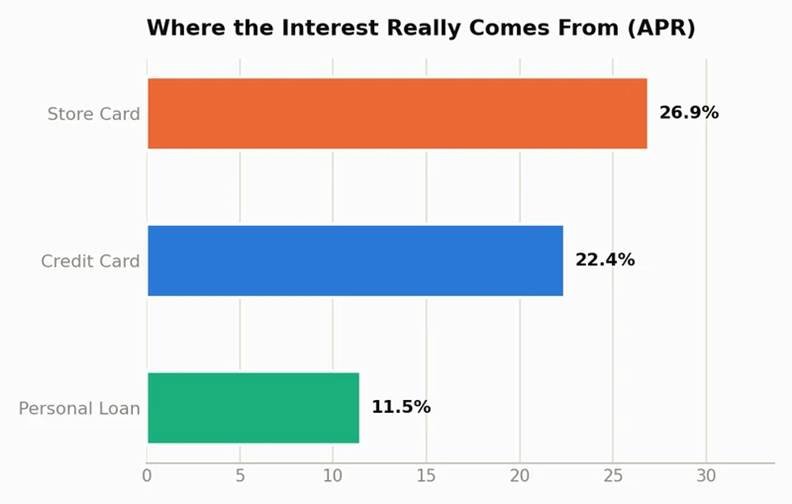
The chart is horizontal and ranks three debts. From the point of view of
The Bottom Line
pure mathematics, the best thing to do is to pay off the debts using the debt debt avalanche method; whereas, from the standpoint of pure psychology, the snowball method should be used. A blended approach delivers a sensible compromise: start by achieving one modest victory to build momentum, then use the mathematically better method for the remaining debts. This debt-reduction strategy is sustainable for most people with more than one debt, and the extra $30 in interest is a small price to pay for a plan that is much more likely to be completed.