 ZenPayoff is a 100% free tool. No hidden fees. No forced registration required.
The comparison between bi-weekly and monthly payments: how the frequency of your payments affects your amortization schedule
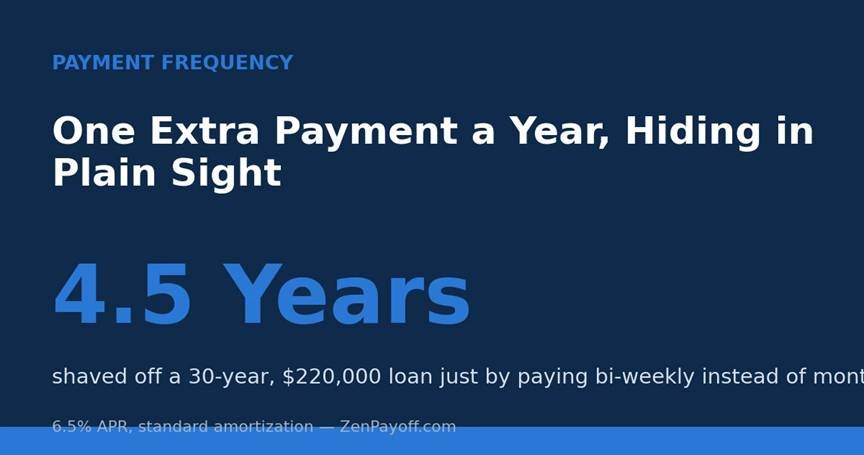
A chart showing that making biweekly payments rather than monthly payments cuts the term of a 30-year loan by 4.5 years.
A comparison of making bi-weekly payments with making monthly payments and the impact of payment frequency on your amortization schedule.
Anyone who has used an early loan repayment calculator when taking out a mortgage, an auto loan, or a personal loan would most likely have come across a rather odd thing: by paying twice a month rather than once a month—without in any way increasing the amount paid each year—it is possible to shorten the term of the loan by several years and end up saving tens of thousands of dollars on interest. This is no magic; it is simply an arithmetic trick that works because of the way the calendar is structured.
The Trick: 26 Half-Payments, Not 24
If you pay half of your monthly payment every two weeks you will end up with twenty-six half-payments in a year because there are 52 weeks in a year and 52 divided by 2 is 26. Twenty-six half-payments amount to 13 full monthly payments rather than 12. You have therefore made one full extra payment each year just by not choosing to pay more, but by altering the schedule.
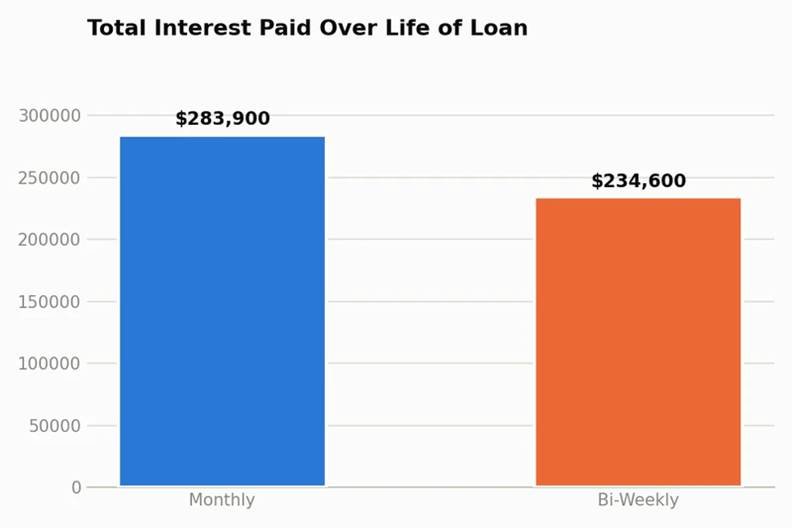
Bar chart comparing total interest charged on a loan under monthly versus bi-weekly payment schedules
The figures show a loan of $220,000 at 6.5 per cent.
This is a typical type of loan, a $220,000 loan over 30 years at 6.5% APR:
- Monthly payments: $1,390/month, 360 payments, total interest paid throughout the life of the loan: ~$283,900
- The amount of each biweekly payment is $695 (since there are 26 of these payments in a year), the loan will be settled in approximately 25.5 years instead of 30, and the total interest paid will be about $234,600.
By altering the payment frequency, the amount of interest paid is reduced by about $49,300 and the loan term is shortened by 4.5 years, all without increasing the total annual amount beyond one additional payment distributed over the year.
Why the Extra Payment Matters So Much
If an additional dollar is paid off early in the term of a loan, the effect is great since the interest is based on the outstanding balance. A payment made in the second year stops 28 years’ worth of interest on that portion of the principal; if the payment is made in the 28th year it only stops two years’ interest. This is the reason why the bi-weekly method has such a significant compounding effect over a 30-year term—the ‘extra payment’ is not simply one extra payment saved; it is the result of reducing the principal earlier each year, and this happens every year during the loan.
Confirming Your Lender Applies Payments Correctly
It is often the case that not all lenders apply the biweekly payments towards the principal right away; instead, some servicers keep the first half of the payment in a suspense account until the second half comes in, and then apply the total amount as a single monthly payment—thus getting rid of the benefit of the extra payment. Before making the switch, you should contact your servicer to find out whether:
- The payments made every two weeks are processed as soon as they are received and are not withheld until the full monthly amount has been gathered.
- There is no fee if you choose the bi-weekly payment plan (though some third-party bi-weekly payment services do charge setup or per-payment fees, which in that case reduce the savings).
- All extra principal received under the accelerated schedule is clearly indicated as a principal-only payment and is not used to meet future interest.
A DIY Alternative to Official Bi-Weekly Programs
If your lender does not provide a true bi-weekly payment option, you can still achieve the same result by dividing your monthly payment by 12 and then making an additional principal-only payment each month. In the case of the $220,000 example, this would involve paying an extra $116 each month along with your regular $1,390 payment, and this approach is mathematically the same as following a bi-weekly payment schedule even without asking your servicer for help or having to worry about delays in the suspense account.
Modeling Your Specific Loan
The amount saved is calculated on the basis of a loan of $220,000 at 6.5%. The balance of your loan, the interest rate and the remaining term will result in different outcomes. Rather than making an estimate, use our free debt payoff calculator to input your real loan figures and compare side by side the monthly and bi-weekly payment plans, noting both the number of years you’ll save and the exact amount of interest that will be reduced.
Where This Strategy Works Best (and Where It Doesn’t)
The greatest savings are achieved with bi-weekly payments on long-term, high-balance loans, particularly mortgages, since compounding has many decades in which to take effect. Although the method still results in money being saved on shorter loans such as a 3-year car loan or a 2-year personal loan, the smaller principal amount and the briefer time frame mean that the savings are more limited, usually amounting to only a few hundred dollars rather than tens of thousands.
Common Mistakes With Accelerated Payment Schedules
- It is a waste of money to join a paid third-party bi-weekly service when the lender you have allows extra principal payments for free; therefore, you should read over your loan documents before agreeing to sign up for any service that charges a fee.
- It is a mistake to assume that the additional payment will be made automatically. When you choose to do the DIY approach, you have to actively tell your servicer that the extra amount should be treated as ‘principal only’ or it might be applied as a partial early payment to your next month’s bill.
- Not checking whether there is a prepayment penalty. Even though most consumer loans no longer have such penalties, a few of the older loans or certain personal loan products still do — so it is important to check the terms before paying off the loan.
- It is common not to keep track of the new payoff date. Many people arrange an accelerated schedule and then never go back to it. If you keep a record of the reduced payoff date, this will help verify that the strategy is working as it should.
The spreadsheet available on Investopedia for amortization makes it clear that making extra payments early in the term of the loan has a greater impact than making them later on; that is the reason why bi-weekly payments result in a quicker payoff. If you are looking after this loan along with other debts, you can obtaina premium debt payoff spreadsheet which will automatically monitor the accelerated payment schedule rather than having to recalculate your amortization table by hand every time you make an extra payment.
A Realistic Look at Cash Flow Timing
A common practical objection I receive is that biweekly payments do not match up smoothly with monthly bills because paychecks, particularly biweekly ones, don’t always come in on the same schedule as the loan’s due date. The solution is simpler than it appears. Most of the services that provide official biweekly enrolment take care of the timing automatically by drafting up half payments as they are received and then applying the total amount to the loan on its regular due date. With the do-it-yourself approach, even greater flexibility is available. As you are only making an extra principal payment once a month rather than actually splitting your payments biweekly, you can arrange that additional amount at any time as long as it is posted before your statement closes.
Twenty and Fifteen-Year Terms Tell a Similar Story
The $49,300 figure mentioned above is based on a 30-year term since it is over that period that compounding has the longest time to take effect. However, the same principle applies to shorter terms as well; for example, on a $220,000 loan over 15 years at an APR of 6.5% paid every two weeks rather than monthly there is still a saving of about $14,000 on interest and the term is reduced by approximately 1.3 years. The percentage of the savings decreases when the original term is shorter since the loan initially has less total interest. Nevertheless, the fundamental maths—that is, making one extra payment each year to reduce the principal earlier—remains true no matter what the term length is.
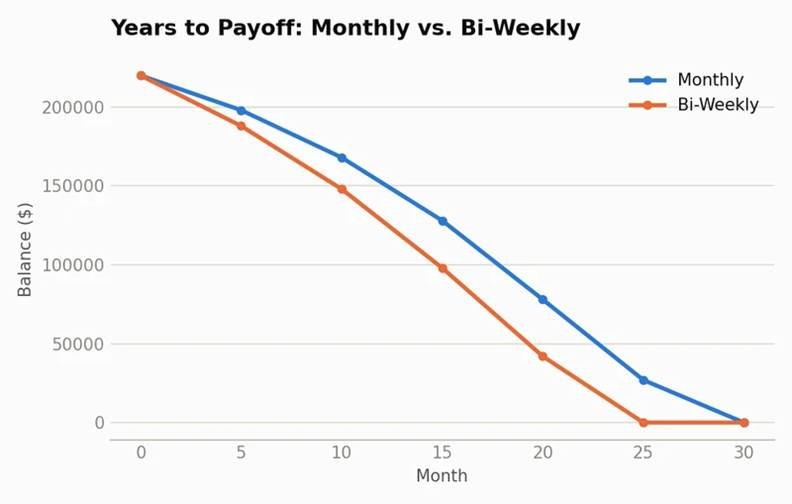
Line chart comparing loan balance decline over time under monthly versus bi-weekly payments
The Bottom Line
Bi-weekly payments are not a special type of financial product; rather, they are a kind of scheduling trick which achieves one additional full payment each year by means of calendar calculations. With a standard 30-year loan, this simple change can result in savings of tens of thousands of dollars on interest and shorten the loan term by several years, as long as your lender carries out the payments properly. It makes no difference whether you use an official bi-weekly program or carry out the same thing yourself by making an extra monthly payment of principal; the mathematics work to your advantage when you act early. The earlier you begin, the more the effect of compounding will benefit you rather than the lender.