 ZenPayoff is a 100% free tool. No hidden fees. No forced registration required.
The Best Way to Pay Off Student Loans Early Without Going Broke
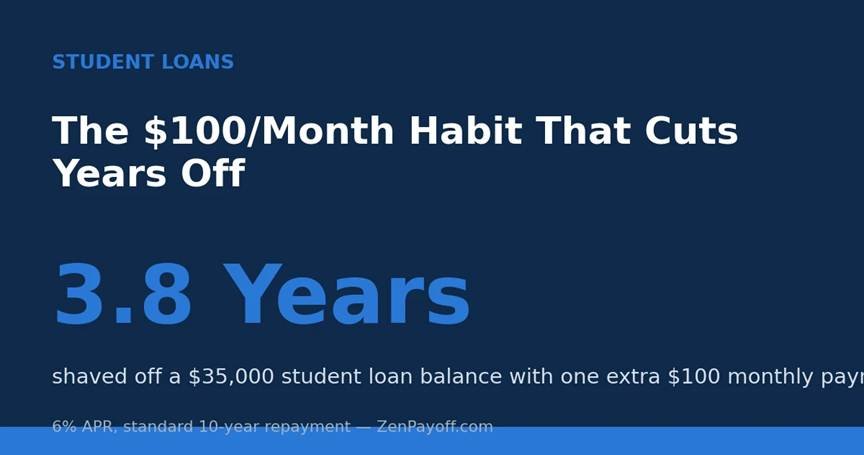
Chart showing an extra $100 monthly payment cutting nearly 4 years off a student loan payoff
The Best Way to Pay Off Student Loans Early Without Going Broke
The most effective method of paying off your student loans early isn’t some secret refinancing trick or a complicated workaround—it’s simply to make a small and regular extra payment going directly to the principal, and do this as early as your finances permit. The mathematical effect of this approach is greater than most borrowers anticipate, and it doesn’t require you to cut back on your entire monthly budget.
The Math: A $35,000 Loan at 6% APR
If you take the typical 10-year repayment plan for a federal student loan—with a principal amount of $35,000, an interest rate of 6 percent, and a standard monthly payment of around $389—the total interest charged over the full term of 10 years amounts to about $11,400.
If you make an additional payment of $100 each month, applied entirely to the principal from the very first day, the loan will be paid off in about 6 years and 2 months rather than 10 years, which is a saving of nearly 3 years and 10 months, and the total interest will come down to approximately $7,280, which represents a saving of just over $4,100.
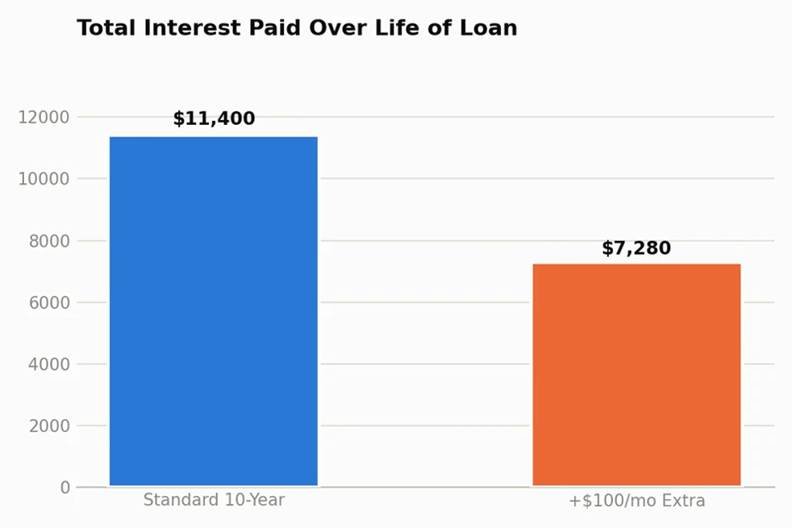
Bar chart comparing total interest incurred on a student loan with and without an extra monthly payment
Why Extra Payments Work So Well Early in the Loan
Just as most amortising debt does, student loans front-load their interest: the early payments consist mainly of interest, and the proportion of the payment going to the principal rather than to interest only becomes more favourable as the balance decreases. If you make an extra payment in the first year, you eliminate nine additional years’ worth of interest on that part of the principal; if you make the same extra payment in the ninth year, you only eliminate one year’s interest. That is the reason why the habit of paying an extra $100 each month has such a big effect—the sooner you start, the more advantage you get from compounding.
Confirming Your Extra Payments Are Applied Correctly
This is an important point that is often missed: student loan servicers do not always automatically use any extra payments to reduce the principal. Instead, many of them apply any overpayment to your payment next month, which amounts to giving you a “payment holiday” rather than lowering the principal—thus nullifying the reason for making extra payments. Therefore, before adopting this approach:
- Get in touch with your servicer yourself and find out the way to indicate a payment as “principal only, current month.”
- After making the first additional payment, check your account statement to make sure that the balance has been reduced by the expected amount rather than just postponing your next due date.
- Each time you change loan providers you should repeat this confirmation because procedures differ from one loan provider to another.
Finding the Extra $100 Without Straining Your Budget
The strategies that work best for finding a sustainable extra student loan payment tend to be modest, not dramatic:
- Send the raise or the cost-of-living increase directly to the loan before it is included in your usual spending baseline.
- To apply half of any tax refund to the principal and to keep the other half for savings or for use at one’s discretion — this prevents the all-or-nothing trap which causes so many windfall-based plans to fail.
- Make the payments come to a rounded figure. For example, if your usual payment is $389, then round it up to either $450 or $500 — the amount of the extra $100 or so seems smaller when you describe it as ’rounding’ rather than as ‘finding an extra $100-plus’.
Weighing Extra Payments Against Other Financial Priorities
It isn’t always the best idea to make extra payments on student loans. When the interest rate on your loan is fairly low (since many federal loans are in the 4-7% range) and you haven’t yet got an employer’s 401(k) match or an emergency fund, it’s usually better to concentrate on obtaining the employer match (which is essentially free money) and building up a small emergency fund before making extra payments on the loan. The order of priority that most financial experts recommend is: to deal with the employer’s retirement match first, then set up a basic emergency fund, followed by high-interest debt, then extra payments on lower-rate debt such as many federal student loans, and finally additional retirement savings.
Modeling Your Specific Loan
The example of $35,000 at an APR of 6% is a typical yet particular case—changes to your balance, interest rate, and the remaining term will affect the exact figures. You can use our free debt payoff calculator to input your real loan details and then see exactly how much time and interest an extra payment of any amount would save you.
Student Loans With Multiple Servicers or Loan Types
A large number of borrowers have more than one federal loan—this could be subsidized loans, unsubsidized loans, or Parent PLUS loans—each possibly managed by a different servicer and carrying its own interest rate. When this occurs, it makes the most sense to direct any additional payments first to the loan with the highest rate, which is exactly how the avalanche method works when applied to your particular collection of loans, in order to get the greatest possible reduction in interest from each extra payment. Since it becomes rather complicated to keep track of loans with varying rates and different servicers by hand, it’s possible to download a premium debt payoff spreadsheet so that all the information about each loan—including its balance, interest rate, and payoff forecast—can be kept in one place.
What Refinancing Changes (and What It Doesn’t)
Refinancing your federal student loans into a private loan may result in a lower interest rate if your credit score and income have improved since you graduated. However, this also means that you will be giving up the federal protections such as income-driven repayment plans, deferment, and eligibility for the forgiveness program. If you are certain that you won’t need those protections and can obtain a significantly lower rate, then refinancing along with making extra payments can build on the savings mentioned above. But if you are uncertain about the stability of your income, it is better to keep your federal loans while still making extra payments in order to retain your options without substantially increasing the cost.
Common Mistakes With Extra Student Loan Payments
- Failing to approve a principal-only application, since any additional payments are instead converted into credits against future payments rather than reducing the interest.
- When there are multiple loans, one should pay the extra amount on the loan with the lowest rate rather than directing the extra payments towards the balance that has the highest rate.
- Taking out a loan solely in order to reduce the monthly payment by extending the term of the loan may in fact result in a higher total amount of interest being paid even if the interest rate is lower.
- Hanging on to the extra payments throughout the natural forbearance period without working out a new payoff schedule when regular payments again begin.
What the Data Confirms
Research carried out by the Federal Reserve into student loan debt indicates that the amounts owed are still rising across the country, highlighting the significant value that even small extra payments can have over a standard 10-year repayment period. This is consistent with the findings of Investopedia’s guide to student loan repayment strategies, which states that making extra payments early in the life of the loan reduces both the total interest and the time it takes to pay off the loan, just as the mathematics shown above demonstrates.
What a Larger Extra Payment Looks Like
Even though $100 a month might be a bit of a stretch whereas $200 a month is something that can be managed, the example of a $35,000 loan shows that the effect can be even greater: making an extra payment of $200 a month reduces the term to about 4 years and 9 months and brings the total interest down to around $5,650 — that is a saving of almost $5,750 when compared with the normal 10-year plan. The relationship isn’t entirely linear (each additional dollar of extra payment saves a little less than the one before it, since as the balance decreases more rapidly there is less interest left to pay off). Nevertheless, the general trend remains: any extra amount that is sustainable and started early performs meaningfully better than delaying it and paying a larger lump sum later in the loan’s term.
A Final Word on Consistency
The situations described above take for granted that the additional payment occurs every month without exception. In reality, if the extra payment is made irregularly—for instance, $100 in some months and then omitted in others—it will still provide a benefit, but the effect will be smaller and less predictable than that resulting from the consistent, automatic approach. The single habit you should adopt from this article is to automate the extra payment in the same way that your regular payment is automated, thereby avoiding the need for yourself to make the decision (and possibly omit it) each month.
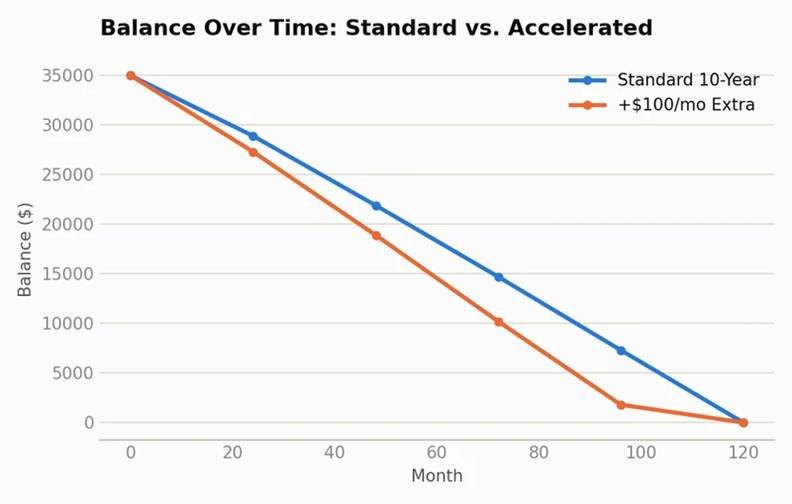
Line chart comparing student loan balance decline over time with and without an extra monthly payment
The Bottom Line
You won’t need to make a radical change to your lifestyle if you want to make a real difference in paying off your student loans—just putting in an additional $100 each month that is actually applied to the principal balance can reduce the time it takes under a typical 10-year repayment plan and result in saving a considerable amount on interest. The sooner you begin, the more valuable that extra payment becomes, so this is one of the rare instances of a financial approach in which starting small and starting today really outperforms waiting until later to make a bigger lump-sum payment.