 ZenPayoff is a 100% free tool. No hidden fees. No forced registration required.
The “Avalanche” Method for Couples: Managing Combined Marital Debt
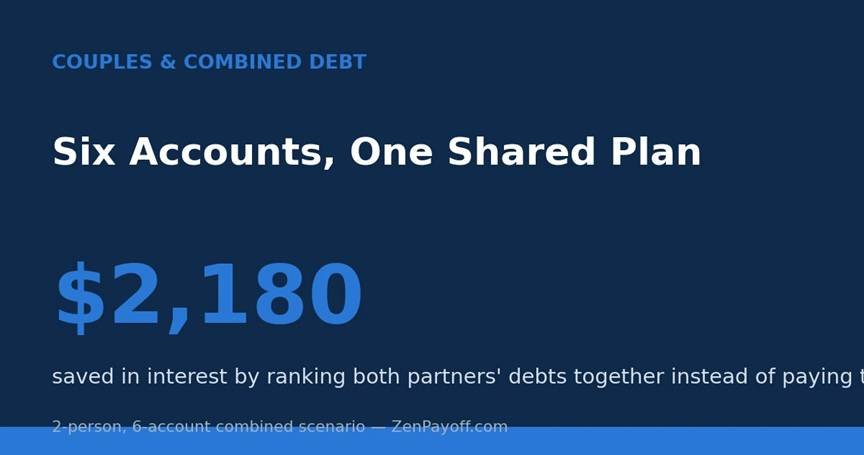
Chart showing combined debt payoff for a couple using an avalanche method across both partners’ accounts
The “Avalanche” Method for Couples: Managing Combined Marital Debt
When couples are dealing with debt jointly, the usual question about whether to use the debt avalanche method or the debt snowball method becomes more complicated in that it is not always clear whether one person’s debt takes priority over the other’s when both partners help pay off the debt from a common budget. Although the mathematical solution is simple—just combine all the debts into one ranked list—the difficulty usually lies in the relationship aspects concerning which debt “counts” first.
The Math: Why Combining Beats Managing Separately
Consider a couple with six debts between them:
- Partner A: credit card ($4,200 at 26% APR), personal loan ($5,000 at 18% APR), auto loan ($9,000 at 6% APR)
- Partner B: credit card ($3,100 at 23% APR), second card ($2,400 at 15% APR), personal loan ($3,800 at 10% APR)
When both partners look after their own debts using individual budgets, the higher-interest debts on each side are tackled at different speeds according to how much each partner is able to contribute on their own—sometimes resulting in a high-interest account (for example, Partner A’s 26% card) being given insufficient attention if that partner has less discretionary income to pay that month.
If the couple instead combines their full monthly payment ability and ranks all six of their debts as a single group on the basis of their APR — that is, carries out a true combined avalanche method — the debt with the highest rate among all those in the household is the one to which the full joint extra payment is applied first, no matter which partner is listed as the owner. When both situations are worked out with a combined monthly payment capacity of $700, the total interest paid in the case of managing the debts separately amounts to about $4,620 for both people; in the case of using a single combined avalanche order the total interest is about $2,440 — representing a saving of $2,180, all due simply to prioritising according to actual cost rather than to whom the account is in the name of.
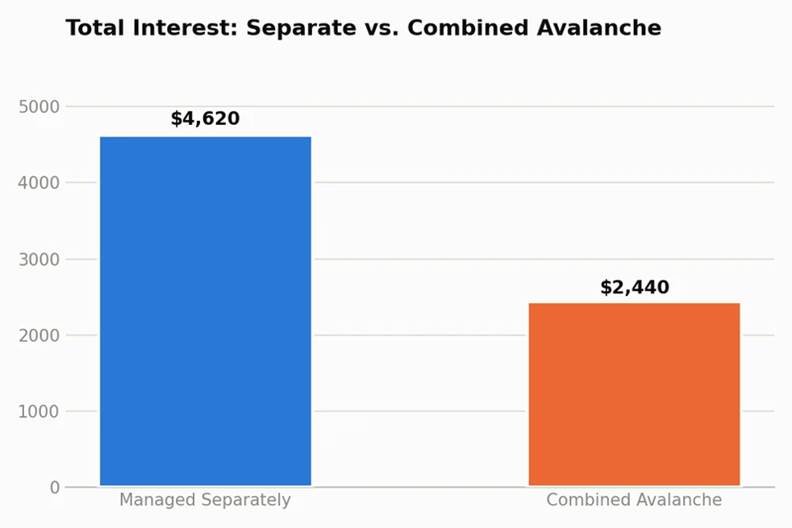
Bar chart comparing total interest paid when partners manage debt separately versus combined
Why This Requires a Direct Conversation First
The figures clearly indicate that merging the debts is the better option, provided that both partners truly agree to regard the debt as jointly owned at least when it comes to the payoff strategy. It is important to state this point clearly since, in reality, it is usually this issue rather than the mathematical calculations that poses the problem: if one partner’s debt is given “first” priority in a combined avalanche method, it can easily seem—without having had an open discussion—that the other partner’s sense of discipline is being used to cover up their own financial mistakes. Approaching the combined method by focusing on the shared figures—the fact that the debt with the highest interest rate costs the household the most regardless of whose name is on it—is far more effective at easing this concern than simply avoiding the conversation.
Building a Combined Plan Step by Step
- Make a single shared document which lists all the debts from both partners, including the balance, the APR, and the minimum payment.
- The partners should agree on the total amount that each of them is going to pay monthly, combined.
- Arrange all the debts in order of their APR, just as is done in the conventional avalanche method.
- Agree on the way in which the minimum payments are dealt with—usually each partner keeps making payments towards their own account’s minimum balance, and the total amount in excess is directed to the debt that has the highest interest rate within the household.
- Let’s review the plan together on a monthly basis since it is the transparency at each stage that keeps the arrangement seem fair rather than one-sided.
Modeling Your Combined Numbers
The $2,180 figure mentioned above is from a particular scenario involving six accounts; your total amounts will be different. You can useour free debt payoff calculator to input both partners’ debts at the same time and see the combined avalanche order as well as the exact interest savings compared to looking after the accounts separately.
What to Do When One Partner Has Much More Debt
It is usual for one partner to join a relationship or a shared financial arrangement with a considerably greater amount of debt than the other. The avalanche method makes no distinction between this imbalance—它 simply ranks the debts by their APR—yet it is important to talk about how the couple wishes to deal with the imbalance on its own, apart from the order in which the debts are paid off. Some couples take the approach described above by combining all their debts; in other cases they opt for a hybrid solution in which each partner remains primarily responsible for their own debt and the partner who earns more or has less debt makes an additional contribution agreed upon by both. There is no one right answer—what is essential is that the arrangement be clearly stated and that both partners agree to it rather than assuming it.
Tracking a Combined Plan Without Confusion
It is really hard to keep track accurately in your head or by referring to various statements of six or more accounts spread between two people, each having different rates, balances, and minimum payments. For this reason, you can download a premium debt payoff spreadsheet designed for tracking multiple accounts, with each partner’s accounts clearly labelled yet all ranked in one combined priority order.
When Keeping Debts Separate Makes More Sense
It is not always the correct approach for couples to combine their debts, particularly when their finances are not otherwise being merged or when one partner is not yet at ease with sharing complete financial information. In such situations, each person can still apply avalanche logic to their own debts by always tackling their account with the highest interest rate first, even if they do not combine their household budgets. In this way, most of the mathematical advantages of the avalanche method can be obtained without the need for a full merger of finances.
Common Mistakes Couples Make With Combined Debt
- Supposing that a merger has to involve a complete financial consolidation (such as joint accounts and shared budgets for all items) when in fact a combined repayment plan can function as a standalone agreement.
- Failing to regularly go over the plan together may cause one partner to feel left in the dark regarding how their contributions are used.
- It is better to completely steer clear of the discussion about “whose debt is whose” since that kind of discussion tends to cause resentment later on rather than stop it.
- When combining debts, treating them according to their balance rather than their APR means that you end up combining them in a way that is equivalent to using the snowball method, even if you don’t realize it.
What the Research Suggests
Although research focusing on debt in specific relationships is scarce, the data available from the Federal Reserve on household debt indicates that the total level of household debt has a significant impact on the overall stability of the financial system, which is the reason why a co-ordinated approach rather than a fragmented one usually leads to better results. According to Investopedia’s explanation of the debt avalanche and snowball methods, the fundamental principle of the avalanche method—paying off the debt with the highest interest rate first—works in the same way whether the debts are held by a single person or are spread across a household.
Handling Unequal Incomes Within a Combined Plan
There is often an unequal contribution by couples to the repayment of a joint debt, this being due either to a difference in income or to different financial responsibilities outside of the relationship. A widely accepted and common method is to allocate their contribution to the joint payment in proportion to their income rather than dividing the additional payment exactly fifty-fifty—for instance, the partner who earns 65 per cent of the household’s total income should pay 65 per cent of the extra amount owed. In this way the principles of the combined avalanche method are maintained (with all debts still being ranked according to their APR, irrespective of who the name on the debt is) and the issue of fairness relating to differing earning powers is taken into account.
Revisiting the Plan as Circumstances Change
A joint debt plan is not a permanent arrangement since things such as a change of job, the birth of a new child, a change in the other partner’s debt circumstances, or simply the passage of time all mean that the plan should be looked at again together. If you include short monthly or quarterly meetings, even just ten minutes spent together reviewing the current figures, this will keep both partners on the same page and stop the plan from becoming one that is managed by a single person while the other loses sight of it.
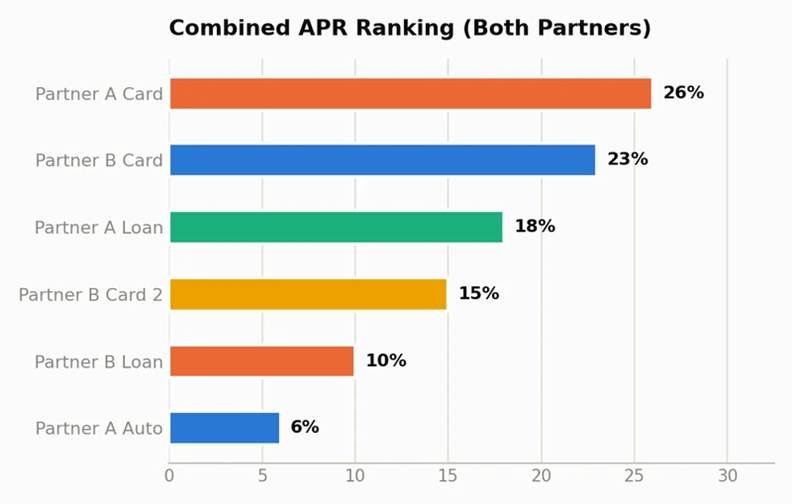
Horizontal bar chart ranking six debts across two partners by APR for a combined avalanche order
The Bottom Line
For both partners who have debt, combining all their debts into one list arranged by avalanche method usually results in saving more money than if each of them looked after their own accounts separately. While the mathematical aspect is not difficult, the more difficult aspect is having a direct and clear conversation about treating the debt as something that is shared, since this approach works much better than either avoiding the subject or making an assumption about how things should be without discussing it.