 ZenPayoff is a 100% free tool. No hidden fees. No forced registration required.
Should I use my emergency fund to pay off the high-interest credit card debt?
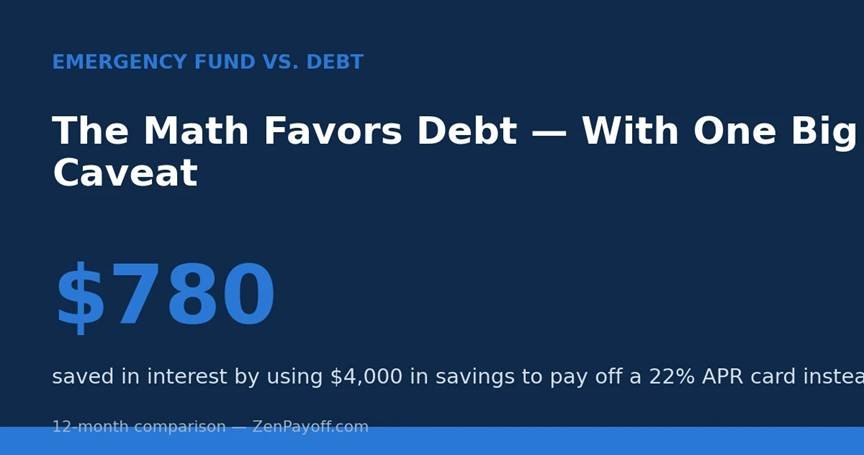
Chart comparing interest saved versus emergency fund risk when using savings to pay off credit card debt
Should I use my emergency fund to pay off the high-interest credit card debt?
If you’re wondering how you can pay off your debt quickly even though you have a fully funded emergency fund and a high-interest credit card balance, the figures give a straightforward answer—but there is an important caveat which pure arithmetic fails to take into account. Let’s consider both aspects.
The Math: Why Paying Off Debt Almost Always Wins
Look at how your money is performing in each location. A sum of $4,000 in an emergency fund in a high-yield savings account yielding 4% APY brings in about $160 in interest over one year. If that same $4,000 is used on a credit card with an APR of 22%, it results in saving roughly $880 on the interest that would have been paid over the same period (assuming the balance would have taken a year or more to pay off otherwise). The net result — ranging from $720 to $780 depending on the exact figures — is money that you retain by transferring the funds from savings to paying off debt, since you are avoiding a 22% cost in order to gain a 4% return, which is a mathematically one-sided advantage in favour of paying off debt.
This rule is generally true: whenever the annual percentage rate on your debt is meaningfully higher than the annual percentage yield on your savings account (since this is the case for almost all credit card debt and almost all savings accounts), it makes more sense to pay down the debt than to leave the money in savings.
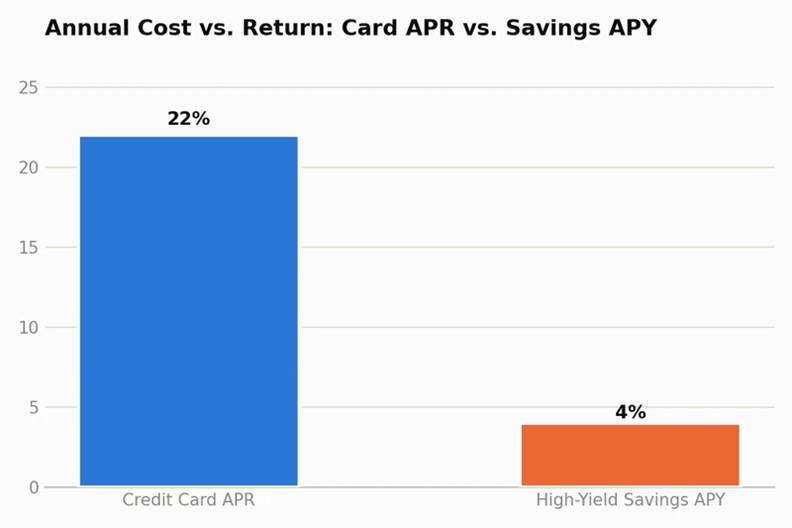
Bar chart comparing the interest cost of credit card debt against the interest earned by a savings account
The Caveat: Liquidity and What Happens If You Need Cash Again
This is where pure mathematics overlooks an important point: an emergency fund isn’t there to earn interest, but to be accessible right away without having to take out a loan when an emergency arises. If you withdraw all the money from your emergency fund to pay off a credit card and then encounter a real emergency — such as a job loss, a medical bill, or an urgent car repair — a month later, the only source of cash you’ll have at that point will be the same credit card that you’ve just paid off, meaning you’ll end up where you started from, without having made any real progress, in addition to suffering the mental strain of feeling as though the payment had never actually been made.
The Middle-Ground Approach That Balances Both Concerns
Instead of making an all-or-nothing decision, partial allocation allows you to gain most of the benefits of the interest-math while at the same time keeping some liquidity—this can be done by maintaining a smaller emergency fund, typically one month’s worth of essential expenses rather than the usually suggested three or six months—and using the remainder on your debt with the highest interest rate. For example, if one month’s essential expenses amount to about $1,200, then $2,800 remains that can be applied to the debt, thus still securing most of the interest savings while having a real (though smaller) safety net.
When to Keep the Full Emergency Fund Intact
Certain situations argue for maintaining a fuller emergency fund even at the cost of slower debt payoff:
- Income that is unstable, due to working as a freelancer on an irregular basis, having a job in an industry which is prone to laying off employees, or having recently changed jobs with a probationary period that is uncertain.
- There is no other means of accessing credit. If the only credit you have is that of the card you are trying to pay off and you possess no other line of credit or family support system, then drawing on your savings completely will leave you in a more vulnerable position than someone who has other options.
- An expense that is known in advance—such as a health problem that will involve continuous costs, a vehicle that is getting older and is likely to need repairs soon, or other similar needs that can be anticipated.
When Draining More Aggressively Makes Sense
On the other hand, it makes better sense to assign a larger portion to debt if you have a steady and predictable income, have access to a secondary line of credit that you are not currently using for this purpose (even if you would rather not have to rely on it), or if you have family support that is available in a real emergency. This is because the calculation of interest costs is more important in such situations, as the liquidity risk is actually lower.
Modeling Your Specific Trade-Off
The particular balance, interest rate and time frame referred to above are just one example; the figures you personally have — namely, your debt balance, the APR, the APY on your savings and the length of time it would otherwise take you to pay off the debt — will affect the exact trade-off. You can use our free debt payoff calculator to work out how much interest a specific amount taken from your savings would save, as compared with the return that money would earn if it remained in your emergency fund.
Rebuilding After a Partial Drawdown
Once you’ve taken the middle-ground approach, you should immediately treat getting your emergency fund back up to a more substantial level as your next priority after the debt has been paid off—rather than treating it as a secondary matter. When the debt balance reaches zero, the same amount of money which previously went towards paying off the debt can be switched directly into savings, so that your safety net is restored on a timeline similar to the one on which you originally drew it down.
Tracking Both Goals Simultaneously
When you are dealing with allocating a portion of your emergency fund against the ongoing repayment of debt, it is useful to look at both figures together rather than keeping them separate. There isa premium debt repayment spreadsheet available which keeps alongside each other a record of your progress in paying off your debt and your emergency fund balance, so that the full financial situation remains visible instead of focusing on one figure at the expense of the other.
Common Mistakes With This Decision
- Emptying the emergency fund right down to zero without taking into account income stability or having any backup plans.
- Not rebuilding the fund afterwards and regardting the drawdown as a one-off event rather than a temporary compromise to be made good later.
- Setting aside the mathematical considerations purely on the grounds of a desire to avoid risk, remaining with high-interest debt for years beyond what is necessary while obtaining a significantly lower return on savings.
- If the psychological cost of having a minimal or no safety net is not taken into account, ongoing financial stress can still result even though the figures technically in favour of the situation.
What the Data Shows
Research carried out by the Federal Reserve into household liquidity has on numerous occasions discovered that a significant number of American households would have difficulty in meeting even a small unexpected expense without having to take out a loan, which shows how important it is to take liquidity into account together with simple interest-rate calculations. Likewise, Investopedia’s guide to determining the size of an emergency fund advises that people should base the size of their emergency fund on the stability of their income and on their current debt responsibilities, rather than applying the same fixed rule to all individuals.
What a Financial Cushion Actually Needs to Cover
It is more helpful when deciding between how much of an emergency fund to keep and how much to use to pay off debt to be particular about the things you actually want to be protected against, rather than relying on a general rule of thumb. Make a list of your real essential monthly expenses—such as housing, utilities, groceries, insurance, and the minimum payments on your debts—and use that figure, not your entire lifestyle expenditure, as the basis for your target amount of a reduced emergency fund. Doing so usually results in a smaller and more attainable buffer than the conventional ‘three to six months of expenses’ recommendation, which is typically calculated based on total spending rather than on the absolute essentials.
Revisiting the Decision as Your Situation Changes
It’s not something you should decide just once and then be done with; since your income stability, the amounts you owe, and your available emergency provisions are likely to change over time, it’s important to periodically check whether the way in which you currently divide your emergency savings and debt repayment is still appropriate. For example, an emergency fund that was reasonable when you had a steady job may need to be rebuilt before a planned change such as starting a new job or entering a period of expected income instability.
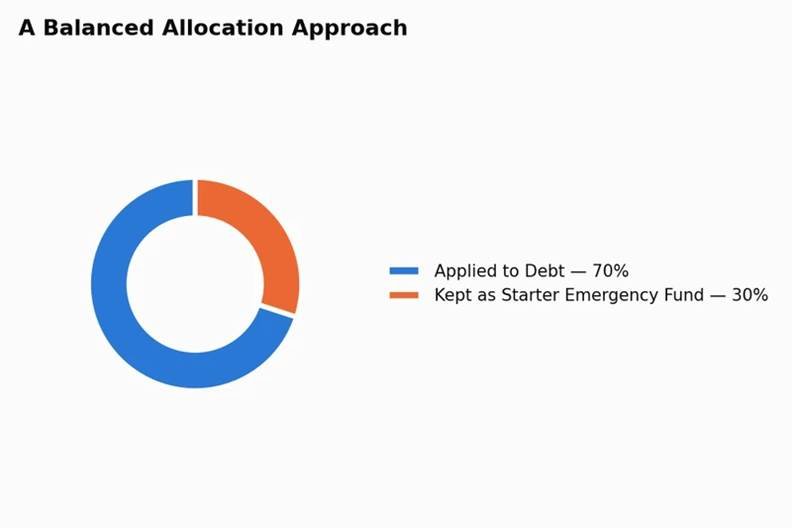
Donut chart showing a recommended partial allocation between emergency fund and debt payoff
The Bottom Line
The math almost always favors using savings to pay down high-interest debt rather than letting it sit earning a much lower return — but liquidity risk is real, not just a psychological concern. A partial allocation, keeping a reduced but genuine emergency cushion while applying the rest toward your highest-interest balance, captures most of the financial benefit without leaving you fully exposed if something goes wrong before the debt is fully paid off.