 ZenPayoff is a 100% free tool. No hidden fees. No forced registration required.
Is it worthwhile to pay off a car loan early? (Comparing depreciation and interest)
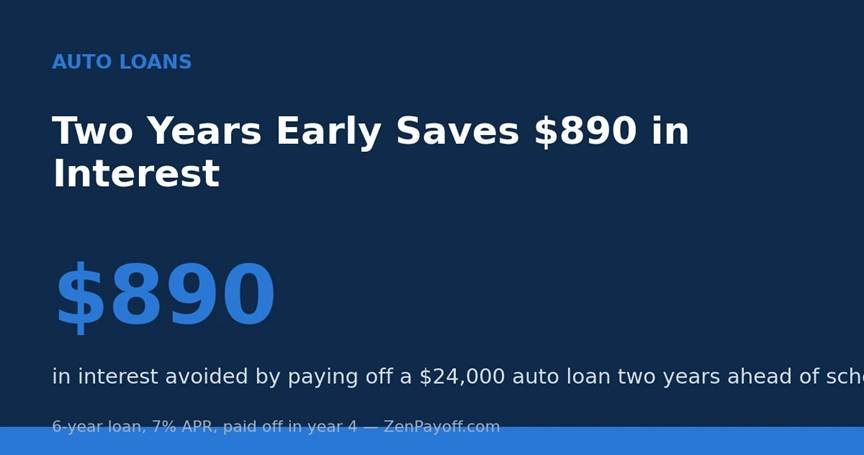
Chart showing interest saved by paying off a car loan two years early
Is it worthwhile to pay off a car loan early? (Comparing depreciation and interest)
It seems like a clear advantage to pay off a car loan early—there’ll be less debt, no more monthly payments, and the matter will be settled. However, when you work the figures using a calculator for paying off a car loan early, the situation turns out to be more complicated than it first looks, since auto loan interest rates are often low enough that although the savings are real, they are smaller than the amount you could earn by making the extra payment somewhere else—and the car’s depreciation curve introduces a factor which doesn’t apply to most other types of debt.
The Math: A $24,000 Loan at 7% APR
If you take out a car loan of $24,000 over 6 years (72 months) at an annual percentage rate of 7%, your standard monthly payment will be approximately $409 and the total interest charged over the full term will be about $5,340.
Imagine that you make additional payments on the principal so as to pay off the loan in 48 months rather than 72—that is, two years ahead of schedule. The total interest then falls to about $4,450, which amounts to a saving of $890. This is a genuine but only fairly small kind of saving when compared with the substantial savings in thousands of dollars that can be achieved on higher-rate debts such as credit cards, since 7% is a low rate to begin with.
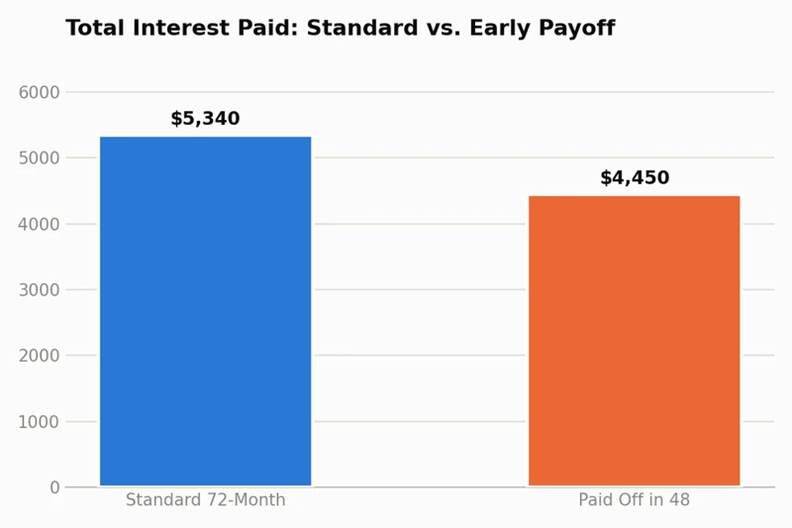
Bar chart comparing total interest incurred on an auto loan with standard versus accelerated payoff
Why Auto Loan Math Differs From Credit Card Math
The main reason why paying off a car loan early saves less than paying off a credit card early is the difference in interest rates: a typical annual percentage rate for an auto loan (about 6-9% for borrowers with good credit, higher for those with poor credit) is a small fraction of the annual percentage rate typical of a credit card (20-28%). What amounts to $890 on a typical balance on a mid-sized credit card would be enough to cover all the interest for an entire year, but would only result in a small reduction on a low-rate auto loan. Hence, when you are deciding between making an extra payment on a car loan and one on a higher-rate credit card, the credit card almost always ought to be the one to which the extra dollar is directed.
The Depreciation Factor Nobody Mentions
The aspect that applies specifically to auto loans is that the value of the car keeps falling throughout the period during which you’re paying off the loan, and this decline in value doesn’t slow down or accelerate depending on how fast you pay off the loan. In the example mentioned, the car’s value falls from about $22,800 (which is already less than the $24,000 loan balance right after the purchase—something that is typical due to taxes, fees, and immediate depreciation) to approximately $10,200 after four years. The loan balance and the car’s value meet somewhere between months 30 and 36, which means that for the first few years you’re in a position where you’re underwater (owing more than the car is worth) no matter how quickly you pay off the loan—paying down the principal in addition to the regular payments actually helps you reach positive equity sooner, a circumstance that becomes important if you might have to sell or trade in the car before the loan is fully paid off.
When Paying Off a Car Loan Early Makes the Most Sense
- You intend to sell or trade in the vehicle before the end of the loan term and would like to prevent yourself from being underwater at that time.
- There is no prepayment penalty on your loan (although most current car loans do not have one, a small number of subprime loans do — make sure to check your contract).
- You have already settled the debt that carried a higher interest rate, since the amount of money you would save by making extra payments on your car loan is less than the amount you would save by applying that money to a balance with a higher interest rate.
- You do have sufficient emergency savings because the money used for a car loan is not liquid; unlike money that is held in a savings account, you wouldn’t be able to access it easily if an emergency occurred.
When It Makes Less Sense
If you still have credit card debt at a rate of 20% or more, it makes no mathematical sense to direct any extra payments towards a car loan that carries 7%; the same amount of money would instead save you a great deal on interest charged on the higher-rate debt. In the same way, if your car loan has an unusually low promotional rate (between 0 and 2%, a situation that often occurs with manufacturer financing incentives), there is very little interest-related advantage in paying it off early; it is more sensible to use that money somewhere else, such as on higher-rate debt, in an emergency fund, or in retirement contributions.
Modeling Your Specific Loan
The amount of $890 given above is based on a 7% APR and a 72-month loan that is paid off in the 48th month; the interest rate, the length of your particular loan, and the remaining balance will all result in a different figure. When choosing between an auto loan and other types of debt, the importance of the comparison outweighs the early payoff benefits of any one loan. You can use our free debt payoff calculator to compare putting extra money towards your auto loan with putting extra money towards other debts you have, side by side.
Confirming No Prepayment Penalty Exists
Before making any additional payments on an auto loan, make sure to check your loan agreement to see if there is a prepayment penalty clause—although such clauses are uncommon on standard bank and credit union auto loans, some “buy here, pay here” or subprime dealer financing arrangements do have one. If the penalty is set as a percentage of the outstanding balance or is a fixed fee, it could抵消 part or all of the interest savings gained by paying early, so it’s worthwhile to take five minutes to check before making extra payments.
Tracking Auto Loan Payoff Alongside Other Debts
When you have an auto loan as well as credit cards or any other kind of debt, the order in which you apply extra payments makes a greater difference than the calculations for any one loan on its own—typically you should pay off the one with the highest interest rate first, no matter what type of debt it is. You’re able to download a premium debt payoff spreadsheet which automatically ranks all your debts by their APR, so you can see whether your car loan or some other balance should get the next extra dollar.
Common Mistakes With Auto Loan Payoff Decisions
- Just going for the auto loan rather than the higher-interest credit card debt because it feels good to get rid of the “big” payment.
- Failing to check for a prepayment penalty before agreeing to an accelerated payoff schedule.
- Failing to take the relationship between depreciation and the vehicle’s balance into account when deciding whether or not to sell or trade in the car before the loan has been paid off.
- Using additional payments on a loan that has a 0% promotional rate when that money could be put to better financial use elsewhere.
What the Data Shows
Data from the Federal Reserve regarding consumer credit indicates that the rates on auto loans have generally stayed well below those on credit cards across all different credit categories, which is the reason why it usually makes sense to focus on paying off higher-rate debt. According to Investopedia’s explanation of loan amortization, the interest savings obtained from paying off a loan early increase in direct proportion to the loan’s interest rate—since a loan with a lower rate has less interest to save initially, no matter how quickly you pay it down.
A Middle-Ground Option: Splitting the Extra Payment
If you have both a car loan and some debt at a higher interest rate but would like the psychological benefit of seeing progress being made on your car loan as well, then you could divide any additional payment — putting the bulk of it towards your highest-rate debt and only a smaller part towards the car loan. Although this approach is not the mathematically best one when compared with strictly prioritising debts, it does deal with the practical issue of wanting to see the car loan balance decrease while at the same time taking advantage of most of the interest savings available on the higher-rate debt. The exact way in which you split the payment will depend on how much you value delayed gratification compared to your desire for visible progress on several accounts at once.
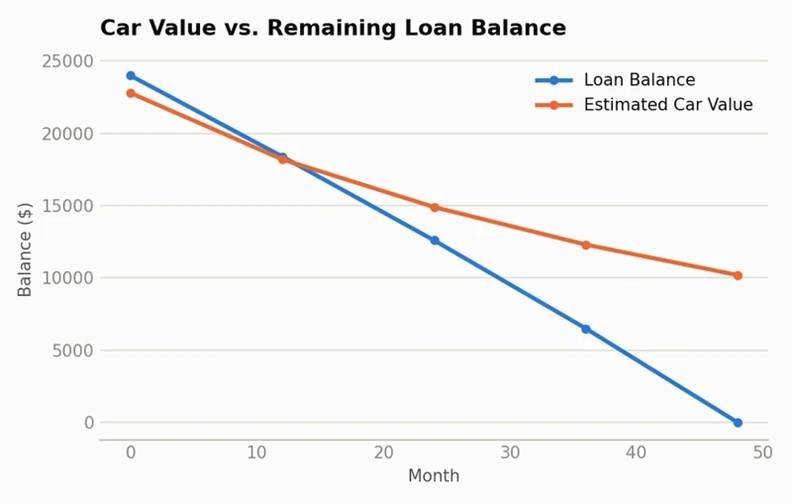
Line chart comparing car depreciation against remaining loan balance over time to assess negative equity risk
The Bottom Line
It does actually save you money if you pay off your car loan early, but the amount of money saved depends on the interest rate of the loan—since for the majority of car loans this rate is considerably lower than the APR on credit cards. In most cases, any debt that carries a higher interest rate should be the one to which you direct your extra payment first. The main benefit of paying off a car loan early isn’t the interest savings but rather the fact that it helps you achieve positive equity sooner, something that is most important if you may have to sell or trade the vehicle before the loan runs its natural course.