 ZenPayoff is a 100% free tool. No hidden fees. No forced registration required.
How to Stop Using Credit Cards While Aggressively Paying Off Debt
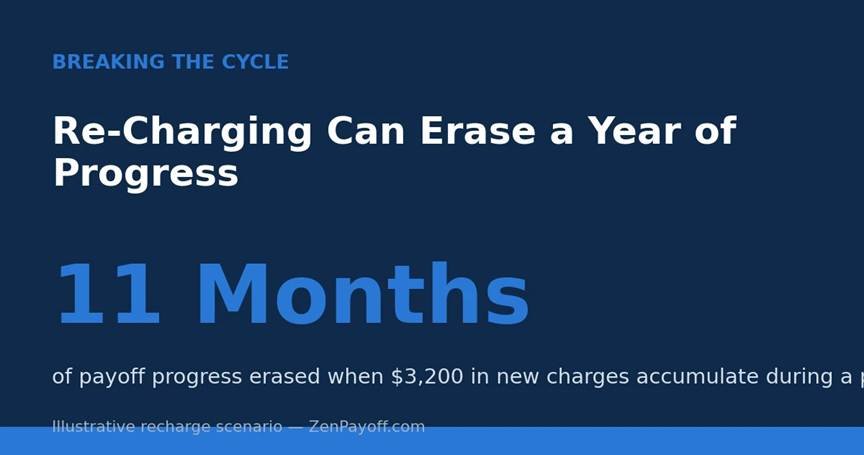
Chart showing how recharging a card during payoff can erase a full year of progress
How to Stop Using Credit Cards While Aggressively Paying Off Debt
Anyone who is really interested in working out how to get out of debt swiftly soon comes across the one habit that ruins more debt repayment plans than any interest rate ever could: that of carrying on making new purchases with the same card they are trying to pay off. Whatever the repayment strategy may be—snowball, avalanche, or any other method—the maths behind it assumes that the balance will only be changing in one direction. As soon as new charges begin to come in again, all the projections become inaccurate.
The Math: What Recharging Actually Costs
A balance of $6,000 at an APR of 21%, paid off with monthly payments of $350, can be completely cleared without any new charges in about 22 months, at a total interest cost of around $1,340.
Imagine that over the same period a total of $3,200 in new charges build up—not all at once, but slowly, by about $150 to $300 per month for various expenses which at the time seem reasonable. Even if the same $350 per month payment is being made, the balance hardly changes for a whole year. By the 24th month, around $3,600 is still left—nearly two full years’ worth of payments having achieved almost no net reduction since the amount paid off is continually offset by the new charges.
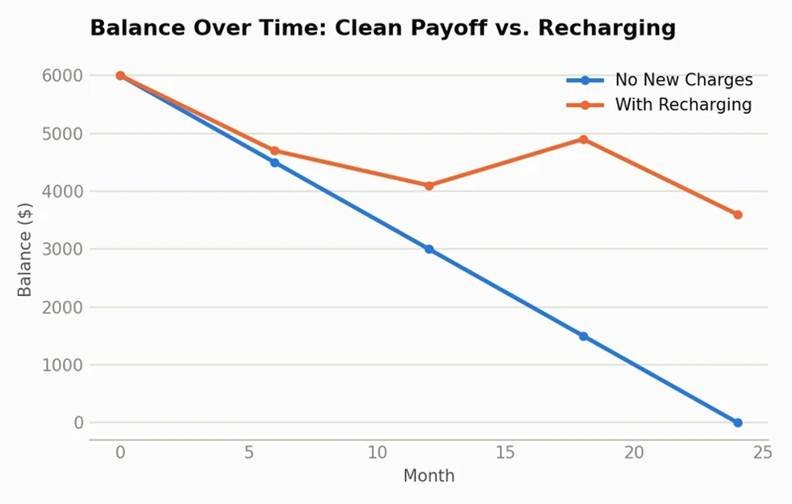
Line chart comparing a clean payoff trajectory against one interrupted by new charges
Why This Happens Even to Disciplined People
Recharging while on a payoff plan almost never takes place because a person completely abandons their budget—it usually happens as a result of a number of individual exceptions that each seem reasonable, such as a car repair that ‘had’ to be done on the card. This holiday season the budget seemed too tight and as a result a subscription or membership was renewed without giving it any thought. Each charge seems justified; together they gradually wipe out a whole year’s progress.
Strategy One: Physical or Digital Separation
The most effective single change is creating actual friction between yourself and the ability to charge the card being paid off:
- Take the card out of the list of stored payment methods on shopping sites and apps since even a friction factor of 30 seconds (that is, having to find the physical card and enter the number) has a meaningful effect on reducing impulse purchases.
- To use the card on a day-to-day basis, freeze or lock it through the app provided by your card issuer, and only unfreeze it when making specific, pre-planned purchases.
- Separate the card from your wallet physically—some people discover that by keeping it at home or in a place that requires a conscious effort to reach, they are able to break the habit of automatically reaching for the card.
Strategy Two: Replace the Card With a Cash-Based System
In the case of discretionary spending categories in which recharging takes place most frequently, changing to cash or a debit card eliminates the possibility of charging those expenses to the card you are paying off since you can’t spend money that you don’t have available. This approach is particularly effective in areas such as dining out, entertainment, and general shopping, since credit cards’ “buy now” convenience facilitates the recharge process.
Strategy Three: Build a Buffer Fund Before Starting an Aggressive Payoff
A large part of the recharging that takes place at the mid-stage of a payoff is due to real, unforeseen expenses—such as a car repair, a medical copay, or an appliance breaking—that are charged to the card because there is no other cash available. If a modest buffer fund of $500 to $1,000 is set aside before deciding on an aggressive payoff plan, the most common legitimate cause of new charges is eliminated, since it is the buffer and not the card that takes on the unexpected expense.
Strategy Four: Track Every Dollar, Not Just the Balance
Focusing just on the total balance of your card can hide what is really going on—the fact that the balance is decreasing slowly could in fact be due to substantial payments being made despite new charges as well, which at first glance seems just like the case of weak payments with no new charges, but demands a totally different solution. By usingour credit card debt tracker to record both your payments and any new charges separately, you will be able to tell right away whether a halted payoff is caused by a payment issue or by ongoing charges.
What to Do If You’ve Already Recharged
If you’ve come across this text since you’ve noticed that your balance is not falling as anticipated, the first thing you should do isn’t feel guilty — instead, you should carry out a fair review to work out how much of the ‘lack of progress’ is due to new charges as opposed to failing to pay the full amount. You can use our free debt payoff calculator to distinguish between these two factors and then recalculate a realistic payoff date on the basis of your current actual balance, not the obsolete projection that was made before you started recharging.
When a Balance Transfer Can Help Break the Cycle
For certain people, shifting the balance to a new card which has a 0% promotional rate and then not using or activating that new card for any purchases results in a kind of psychological reset—since the old card can now be closed or frozen and thus the temptation is removed, the new card is in the mind simply seen as “debt to pay off” rather than as a means of spending. However, this approach will only be effective if you actually regard the new card as off-limits when it comes to purchases; if you don’t do this, the same cycle will once again occur with a new account.
Common Mistakes When Trying to Break the Cycle
- Underestimating small recurring charges: even though no single charge seems important, a few $30 to $50 impulse purchases each month can total hundreds over the duration of the payoff plan.
- Since there is no emergency buffer, genuine emergencies have to fall on the card which is being paid off.
- Having the card readily available in a wallet or as a saved payment method, so that it removes the obstruction which would otherwise cause a spontaneous purchase.
- Rather than considering one mistake as a complete failure, it is better to identify the specific trigger and deal with it before it occurs again.
What the Data Shows
Data onconsumer credit from the Federal Reserve indicate that revolving balances have continued to stay high among households throughout the United States, a situation which is in keeping with new charges being made all over the country that counteract repayment efforts. Likewise, Investopedia’s guide on breaking the credit card debt cycle stresses that it is often the changes in behaviour—not just the payment strategy—that determine whether a debt payoff plan is successful.
A Realistic Expectation for the First Few Months
It’s unlikely that you’ll successfully break a recharging habit on your first try — a more realistic expectation is to see a gradual decrease in the number of new charges over a period of two or three months rather than to achieve a complete stop right away. The important thing is the trend: if the number of new charges decreases each month as the friction and buffer strategies become effective, then the plan is working, even if one or two charges do manage to slip through. A single relapse charge should be treated as a lesson to learn from, not as proof that the entire approach has failed.
Why This Matters More Than Which Payoff Method You Choose
It is better to be straightforward here: the difference between choosing a snowball approach and an avalanche approach, or whether or not to consolidate, means far less than whether or not new charges continue to build up. An ideally structured avalanche strategy will perform worse than an imperfect snowball strategy combined with actually stopped new charges. So if you can only concentrate on one aspect of all the debt-payoff advice, concentrate on this one first.
Enlisting Support When Willpower Alone Isn’t Enough
If you’ve already tried the friction-based methods mentioned above but still discover that new charges are appearing again, then you should tell a reliable friend or partner about your exact goal and deadline. Just knowing that another person is aware of your commitment gives you a degree of accountability which pure self-discipline occasionally does not provide, and an additional point of view can help you to spot recharge triggers that you might not pick up on when looking at your own spending patterns.
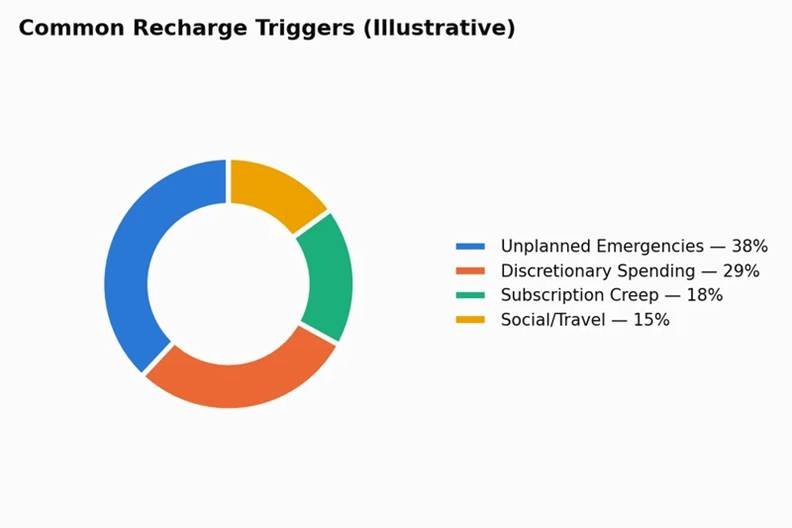
Donut chart showing common categories that trigger recharging during a debt payoff plan
The Bottom Line
No matter how mathematically optimal a payoff strategy may be, it will not survive continuous new charges being made to the same account. To break the recharge cycle you need more than just determination—you have to eliminate the easy access which makes it so simple to recharge, set up a buffer for real emergencies, and keep track of your payments and any new charges separately so that you can clearly see whether your plan is working.