 ZenPayoff is a 100% free tool. No hidden fees. No forced registration required.
 How to Pay Off $10,000 in Credit Card Debt in One Year: A Mathematical Case Study
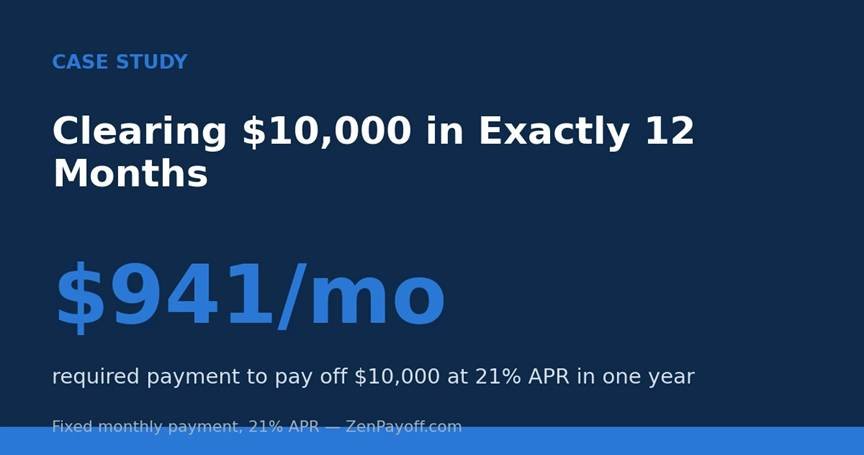
Chart showing the monthly payment required to clear $10,000 in credit card debt in exactly 12 months
How to Pay Off $10,000 in Credit Card Debt in One Year: A Mathematical Case Study
When someone asks me about the quickest method of paying off credit card debt, they usually have a certain amount in mind—often $10,000—and a time frame, typically within a year. Let’s construct that case study with actual calculations, using a $10,000 debt at 21% APR, near the current national average for revolving balances.
Setting the Target: What “One Year” Actually Requires
If you want to pay off $10,000 at 21% APR over 12 months, your monthly payment must be $941. This includes interest charged on the decreasing balance each month—it is not just $10,000 divided by 12, which would be $833. The extra $108 per month covers about $1,290 in total interest paid during the year as the balance decreases.
Here’s how the numbers unfold at key checkpoints:
- Month 1: Balance $10,000 → interest charged ~$175 → payment $941 → new balance ~$9,234
- Month 6: Balance ~$5,550 → interest charged ~$97 → new balance ~$4,706
- Month 12: Final payment clears the remaining balance to $0
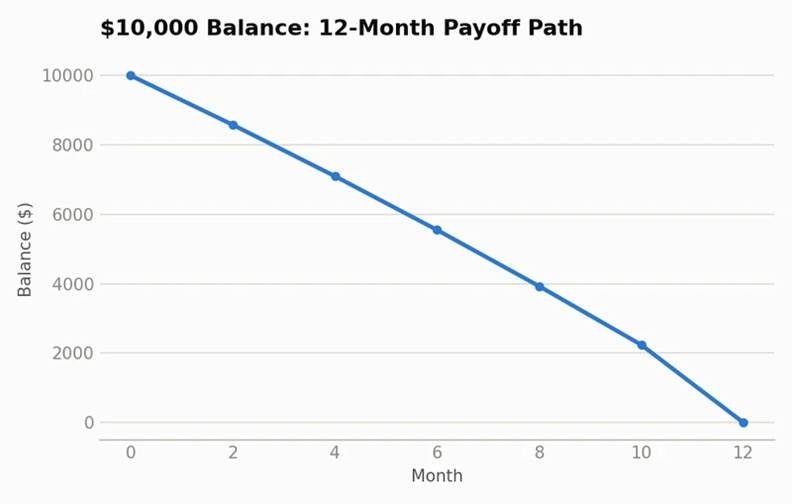
Line chart showing a $10,000 balance declining to zero over 12 months
Why the Math Gets Harder the Longer You Wait
If a 12-month timeline isn’t realistic for your budget, the required monthly payment drops — but total interest accumulated rises, because the balance has more time to accrue charges:
- 12 months: $941/month, ~$1,290 total interest
- 18 months: $646/month, ~$1,930 total interest
- 24 months: $501/month, ~$2,620 total interest
- 36 months: $361/month, ~$4,010 total interest
If the period is extended from 12 to 36 months the interest paid increases by about three times, even though the monthly payment falls by more than half. This is the key choice that anyone who wants to pay off their debt quickly actually has to face: going for a shorter period means paying less in total but requires a greater amount from your monthly budget at present.
Where the Extra $941 a Month Actually Comes From
For most households, finding an extra $900+ a month isn’t about cutting daily coffee—it usually requires a combination of approaches:
- Checking over recurring subscriptions and renegotiating the bills (for insurance, phone plans, and streaming services) can often save between $50 and $150 a month if you only spend a single afternoon on the phone.
- If you are expecting a tax refund or an annual bonus, then divide the windfall by 12 and commit the corresponding amount each month so that your payments remain steady rather than being made all at once.
- A temporary extra source of income—such as $300 to $400 per month from doing freelance work, selling items one doesn’t need any more, or taking on additional shifts—can cover a significant portion of the gap.
- Transferring the debt or consolidating it into a lower interest rate will reduce the amount that needs to be paid over the same 12-month period (refer to the mathematical adjustment below).
What a Lower Rate Does to the Same Timeline
If you manage to obtain a 0% or a low-interest balance transfer for part of the balance, the monthly payment you need to make in order to pay off the debt in 12 months will drop considerably. When the interest rate is 3% rather than 21%, the same balance of $10,000 will require only about $847 per month to clear within a year—thus saving nearly $100 each month over the same period of time, since almost no part of that payment goes towards interest.
Modeling Your Own Numbers
The $10,000-at-21%-APR example can serve as a useful benchmark, but your real balance, interest rate, and the amount you can pay each month will be different. Instead of making an estimate, you can use our free debt payoff calculator to input your exact figures and find out the exact monthly payment needed for any desired time frame, together with the total interest you would pay in each case.
Staying on Track for 12 Full Months
A 12-month payment plan will only function if you pay each month without missing any — if you miss or reduce a payment at the beginning of the plan, the payoff date will be pushed back by two or three months, as the extra interest accumulated has to be covered somewhere. A number of readers find it easier to remain disciplined when they can see the plan laid out in advance rather than having to recalculate each month; you can download a premium debt payoff spreadsheet which shows your exact balance for all 12 months, so any deviation from the plan becomes obvious right away instead of being noticed at month 10.
Common Mistakes in Aggressive Payoff Plans
- Setting an unrealistic monthly target will cause the plan to fail within a few months if $941 per month cannot actually be achieved considering your income and fixed expenses. Instead, select an 18- or 24-month timeline that you can keep to rather than stick to a 12-month target which you will abandon.
- If new purchases are not taken into account. The calculation based on this math makes the assumption that no further charges will be made to the card. When the card is used again, the balance calculation is reset each month.
- Ignoring the risk associated with variable rates. Since many credit cards link their APR to the prime rate, this rate may change during the period in which you are paying off the balance and will therefore cause the amount you are required to pay to change slightly.
- Underestimating the mental strain caused by a tight budget; an aggressive payoff over 12 months is like a sprint rather than a marathon—so include a small buffer for unexpected expenses to prevent the whole plan from being ruined by one bad month.
What Authoritative Sources Say
The data onconsumer credit from the Federal Reserve indicates that revolving debt balances have remained high at all income levels, so a debt of $10,000 is by no means an unusual situation. Moreover, Investopedia’s guide to debt payoff strategies also stresses that the shortest possible payoff periods depend on having a fixed and unchangeable payment amount as well as a realistic assessment of total monthly cash flow prior to establishing the plan.
What I’ve Seen Work in Practice
When I have gone through this exact situation with many ZenPayoff readers, the ones which actually make it to month 12 all have one thing in common: they regard the $941 payment as a bill rather than as a goal. Instead of keeping it as ‘whatever is left over’ at the end of the month, they arrange for it to be automatically transferred the day after their payday, before making any discretionary spending. The plans that fail to progress usually begin in the same way — with a solid performance in the first two or three months — but then the payment begins to shrink as soon as an unexpected expense arises and never fully recovers.
Frequently Confused Points
Will making additional payments that are made only towards the principal help? Yes — any amount paid in excess of the required $941 will go entirely to the principal (on the basis that there are no fees), thus bringing the time frame below 12 months or lowering the amount of payments that will be due in the future. However, you should check with your credit card issuer to confirm that such extra payments are applied to the principal rather than being held as credit towards next month’s minimum payment.
Even if my APR isn’t precisely 21 per cent, the relationship still holds in terms of direction: if the APR is lower then the monthly payment needed for the same 12-month target will be lower and if it is higher then the payment will be greater. The differences expressed in percentage points have a greater effect than most people realise — a three-point difference in rate on a $10,000 balance results in the monthly payment having to change by about $25 to $30.
Is a 12-month time frame always the best aim? By no means. It is an ambitious yet attainable goal for many households who have a debt of $10,000 and a steady income. However, if the monthly payment required were to take up too large a portion of your budget, then a longer and sustainable repayment plan that you actually finish is mathematically worse but in practice better than a 12-month scheme which you give up after five months.
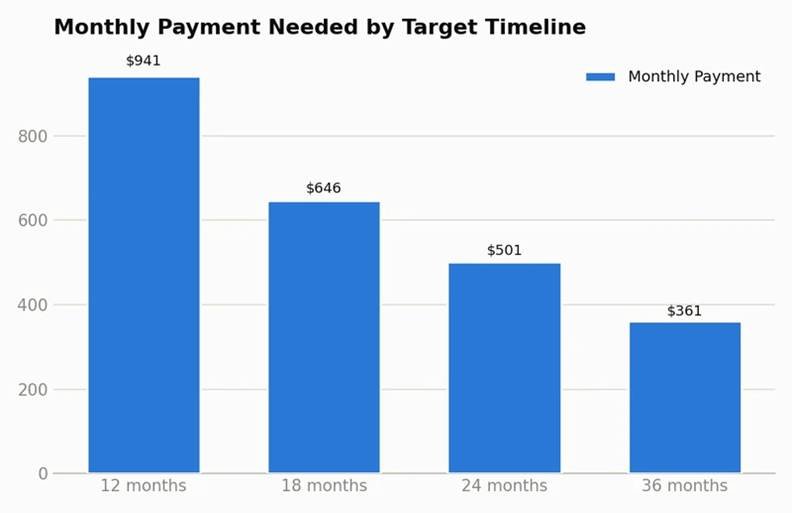
Grouped bar chart comparing monthly payment amounts against payoff timelines for a $10,000 balance
The Bottom Line
It is entirely possible to pay off $10,000 of credit card debt within a year if you apply the correct mathematical approach—making a fixed monthly payment of $941 against a 21% APR will achieve this, at a total interest cost of about $1,290. Should that amount not fit within your budget, delaying the repayment isn’t a sign of failure; it’s just a different, yet still valid, approach that will cost you more in interest. The most important thing is to work out your own figures rather than making guesses, and to commit to a payment that you can afford for each and every month of the repayment plan.