 ZenPayoff is a 100% free tool. No hidden fees. No forced registration required.
How to Get Out of a 29.99% Penalty APR Trap on Your Credit Card
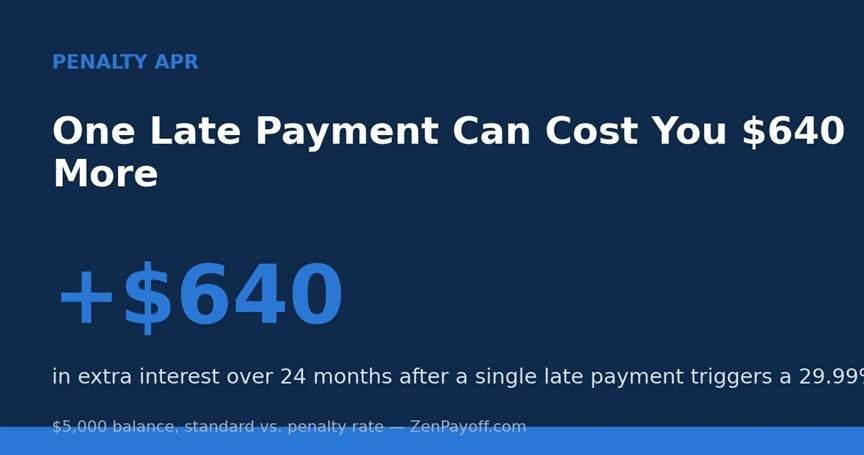
Chart illustrating the additional interest cost that results from a 29.99% penalty APR as opposed to a standard 22% rate
How to Get Out of a 29.99% Penalty APR Trap on Your Credit Card
A penalty APR—typically 29.99% or above—is one of the most costly pitfalls in consumer credit and can be triggered by a single payment arriving a few days late. Fortunately, if you want to get rid of credit card debt quickly after being placed on a penalty rate, the rate isn’t always permanent and there is a clear procedure to get out of it.
How a Penalty APR Gets Triggered
Under the CARD Act, card issuers are legally allowed to impose a penalty APR if a payment is more than 60 days late. Yet a large number of them apply it following just one late payment, as stated in the terms of their cardholder agreement. When such a penalty rate is activated, it is generally applied to your current balance rather than only to any new purchases—so a rate which originally might have been something manageable like 18 to 22 per cent can suddenly rise to 29.99 per cent or more, greatly increasing the cost of holding the same balance.
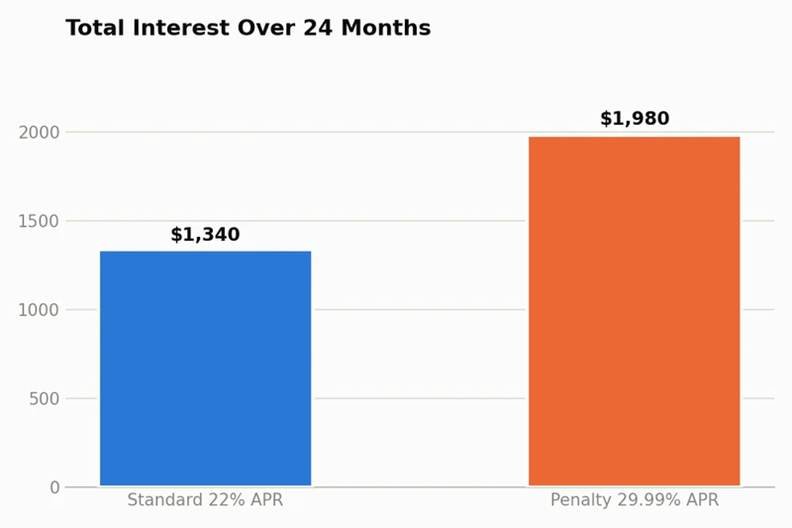
Bar chart comparing total interest paid at a standard APR versus a penalty APR
The Math: What the Penalty Rate Actually Costs
Consider a balance of $5,000 which usually carries an interest rate of 22% APR. At the standard rate, a monthly payment of $250 will pay off the balance in approximately 24 months, the total interest amount being about $1,340. However, if a late payment causes the APR to rise to 29.99%, then making the same monthly payment of $250 will now take around 26 months to clear the balance, the total interest in this case being roughly $1,980—that is an extra $640, all of which is due to the one missed payment that led to the penalty rate being applied.
Step One: Confirm the Penalty Is Legitimate
Before you conclude that the penalty rate is fixed, you should check your cardholder agreement and your most recent statements to find out the exact condition that triggers it. The companies that issue the cards are required to make their penalty APR terms clear, and in some cases a late payment that was the result of a mistake or a system error (for example, a payment that was submitted on time but was processed late because of an error by the bank) can be reversed if you have the necessary documentation.
Step Two: Request Reinstatement of Your Standard Rate
According to the CARD Act, when a late payment has caused your interest rate to rise to a penalty rate, your credit card company is required to look at your account after you have made six payments on time in a row and should then consider bringing your rate back to the original one if your payment record has gotten better. However, this does not happen in all situations—you may have to phone them and ask them to carry out the review yourself—but it is a legal right and not something that is offered as a favour, so it’s worthwhile to contact them directly rather than assuming that the penalty rate will stay in place.
Step Three: Make the Six Months Count
When you are working to regain your eligibility, each payment is important because if you have one further late payment during the six-month period the clock will be reset and the penalty rate can continue for ever. It is during this time that automating your payments (instead of depending on manual reminders) gives you the greatest benefit, since the cost of one further mistake is especially high while a penalty APR is in effect.
Step Four: Consider a Balance Transfer or Consolidation
If neither reinstatement nor the new rate offered are feasible, you can transfer the balance to a 0% promotional balance transfer card or take out a lower-rate consolidation loan in order to get rid of the effect of the penalty rate, since you will be paying off the original card and beginning again under new terms. This is usually the quickest method of getting rid of a penalty rate when the servicer is slow to reconsider it. The problem is that you have to qualify for new credit, and this can be difficult right after a late payment shows up on your credit record.
Modeling Your Own Penalty Rate Situation
The $640 figure mentioned above applies to one particular combination of balance and interest rate—your results will differ according to your balance, your standard rate, and the length of time that the penalty rate remains in effect. By usingour free debt payoff calculator, you can compare the timeline it takes to pay off your debt at the penalty rate with the scenario in which the standard rate is reinstated, thereby helping you to decide whether you should carry out an aggressive payoff now (in order to reduce the interest accrued at the penalty rate) or wait until you become eligible for reinstatement.
Preventing a Penalty APR From Happening Again
After you’ve handled a penalty rate, the best way to prevent further problems is to get rid of the possibility of missing a payment altogether—so arrange for automatic payments for at least the minimum amount on each card, even if you’re currently paying more than the minimum on some of them by hand, in order to make sure that a forgotten manual payment doesn’t result in a late fee or penalty rate. Those people who manage a number of credit cards often find it helpful to useour credit card debt tracker to have all the due dates, autopay status, and the current rates for each of their accounts in one place.
Common Mistakes When Dealing With a Penalty APR
- On the basis that the penalty rate is permanent and not requesting the review required by the CARD Act after making six on-time payments.
- Failing to make a payment within the six-month reinstatement period, thereby resetting the clock.
- Failing to find out if the penalty applies to the whole of your balance or only to new purchases — the terms differ according to the issuer and the cardholder agreement.
- Opening a new balance transfer card without having a clear plan for how to pay off the debt, just transferring the same debt to a new account without tackling the spending and payment habits that caused the late payment.
What Consumer Protection Sources Confirm
The consumer protections provided under the CARD Act, which are in part enforced by the Federal Reserve’s regulations concerning consumer credit, mandate that issuers examine penalty-rate accounts when a customer has a continuous record of paying their bills on time. Likewise, Experian’s guide on penalty APRs states that reinstatement is not automatic in most instances and that cardholders usually have to ask their issuer directly to arrange the review.
What to Say When You Call Your Issuer
When asking for your account to be reinstate, it’s best to be clear and particular rather than general. One good way to do this is to mention that you know the CARD Act mandates a review of penalty APR accounts after six payments have been made on time, to state the number of consecutive on-time payments you’ve made, and then to ask specifically if your account is now eligible for review. Representatives are more likely to pass on or take action in response to a specific and well-informed request than to a general enquiry such as ‘can you lower my rate’, since the former refers to a definite right rather than a discretionary favour.
How Long a Penalty Rate Typically Lasts If Left UnaddressSome issuers will eventually reinstate the standard rate without any request from the customer, even though they continue to make their payments on time and without a subsequent call being made; however, this does not happen guarantee and may take a great deal longer than the six-month legal minimum. In practice, it is more reliable to treat reinstatement as something that you have to actively request rather than something that occurs automatically.ath.
Documenting Everything Along the WMake a simple record of each call—include the date, the name of the representative if one is given, and a summary of the discussion—regarding your penalty rate and reinstatement request. When a credit card issuer is slow to carry out the reinstatement review required by the CARD Act, having a documented history of your requests makes your subsequent follow-up calls more effective. It gives you a written record should you ever need to take your complaint forward to the Consumer Financial Protection Bureau.eau.
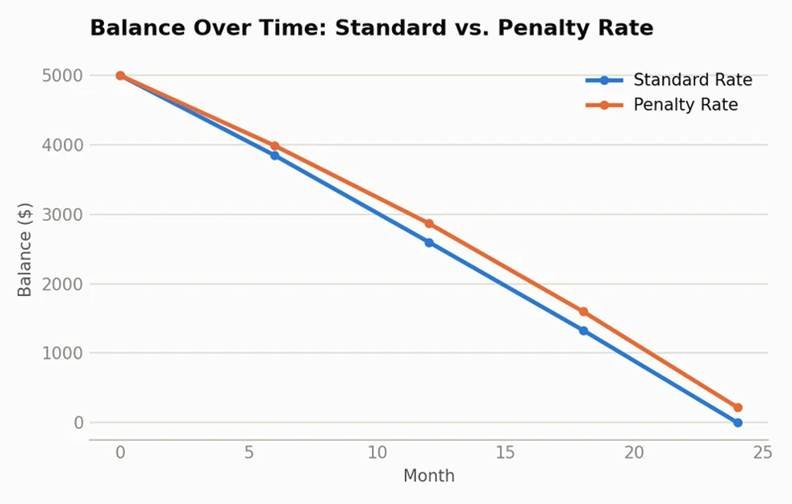
Line chart showing how a penalty APR extends A penalty APR is expensive but not necessarily permanent.
The CARD Act gives you a legal path back to your standard rate after six consecutive on-time payments. Until then, prioritizing this balance and automating every payment protects against a single slip extending the penalty period. If reinstatement is slow or unavailable, a balance transfer or consolidation loan offers a faster way to reset the rate entirely.r consolidation loan offers a faster way to reset the rate entirely.