 ZenPayoff is a 100% free tool. No hidden fees. No forced registration required.
How Student Loan Daily Interest Accrues (And How to Beat It)
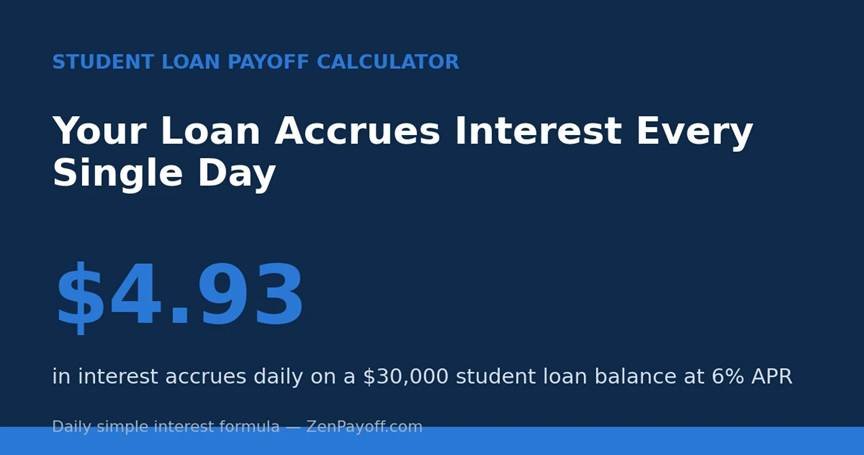
Chart showing how much daily interest accrues on a student loan balance each day
How Student Loan Daily Interest Accrues (And How to Beat It)
Although most borrowers know their APR, they have never seen the formula their loan servicer uses to charge interest daily rather than monthly on the exact balance owed. By understanding this system, instead of viewing your loan as a black box checked only occasionally by a payoff calculator, you can discover a simple timing trick that can significantly affect the amount you pay.
The Daily Interest Formula
Most federal and private student loans use a daily simple interest formula:
Daily interest = (Outstanding principal × Annual interest rate) ÷ 365
For a $30,000 balance at 6% APR, (30,000 × 0.06) ÷ 365 equals $4.93 daily. This interest accumulates every day the loan exists, regardless of whether your monthly payment has been made.
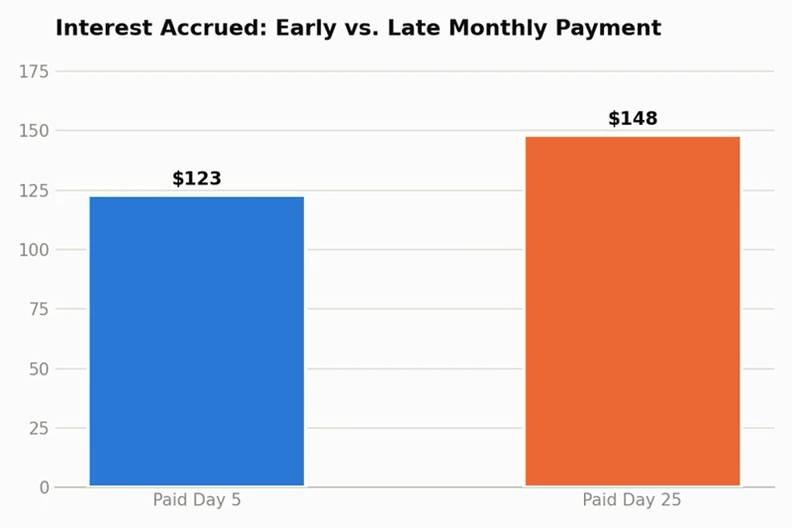
Filename: best-way-to-pay-off-student-loans-payment-timing.webp
Alt Text: Bar chart comparing interest accrued when paying early in the billing cycle versus late
Why This Means Payment Timing Actually Matters
Since interest is charged every day rather than being computed only once a month, the amount of interest you pay will vary each time you make a payment even if the amount you pay and the due date remain the same. For instance, making a payment on the fifth day of a 30-day cycle rather than on the twenty-fifth day means that the loan earns interest for twenty fewer days on the balance existing before the payment that month. Over the course of a full year, regularly making payments at the beginning of each cycle rather than on or around the due date can result in saving a small but actual sum—in the example above with $30,000, this amounts to roughly $25 to $30 over the year simply as a result of the timing of the payment, with no alteration to the total amount paid.
The Bigger Lever: Extra Principal Payments Timed Early
Although making payments at a certain time brings only a small saving, the more effective strategy is to pay down the principal in extra amounts during the month. As interest is charged each day on the current balance, an additional payment made on the third day of the month lowers the balance on which interest is calculated for the other 27 days of that period; whereas an identical extra payment made on the twenty-seventh day has only a effect of reducing the balance for three days before the cycle starts again. If you have the habit of making extra payments, it is best to do so as early in the month as possible (rather than putting all the extra payments into one payment close to the due date) in order to get the greatest benefit from the daily interest.
How Weekends and Holidays Complicate the Math
A point that many people who are borrowing fail to realize is that the system used by your servicer to apply a payment is not always immediate. A payment made on a Friday evening or before a holiday weekend might not be applied to your account — and interest could continue to accrue on it — until the following business day. When you are trying to time your payments in order to reduce the amount of interest, it is better to submit them a few business days before your desired date rather than on that date exactly.
Confirming Interest Doesn’t Capitalize Unexpectedly
When interest is allowed to capitalise—that is, the interest that has accumulated but not yet paid is added to the original amount you owe, so that then it starts to earn interest as well—the effect is particularly expensive. This kind of thing usually occurs at the end of a deferment or forbearance period, or when you change your repayment plan. If you are aware that a period of non-payment (for example, a forbearance) is coming up, you can avoid making that accrued interest permanent by paying some of it off before it capitalises, even if only a portion.
Modeling the Combined Effect
The effect of early payments, the timing of extra payments, and the avoidance of capitalization all combine, the total result being greater than that of any one of the individual strategies. Instead of having to keep track of all three yourself, you can use our free debt payoff calculator to see how a combination of making early payments and regularly adding extra principal amounts affects the total interest that will be charged on your particular loan.
What This Looks Like Applied Consistently
Throughout the entire loan term, if you consistently follow these timing rules—paying a little early each cycle, making the extra payments earlier in the month rather than later in it, and avoiding unnecessary capitalisation—you can end up with substantial savings, typically amounting to a few hundred dollars over the multi-year duration of the loan, in addition to the savings resulting from the extra payments themselves. Although the impact is smaller than that of the extra-payment methods described in most general debt reduction strategy books, it is a free, cost-free adjustment that involves no change to the amount you are actually paying.
Tracking Payment Timing Alongside Your Broader Plan
When you are looking after a student loan together with other types of debt, the specific points about timing mentioned above are of less importance than the general sequence in which you pay off your debts—but they can still be a helpful adjustment once you’ve already decided on your overall strategy (that is, which debt to prioritize and how much extra to pay). You can geta premium debt repayment spreadsheet which records both your actual payment dates and your balances, making it easier to tell whether you are consistently making payments early or late in each cycle.
A Note on Federal Loan Servicer Differences
Different servicers do not make their daily accrual information just as clear — some prominently display a running figure for ‘interest accrued since the last payment’. On the other hand, others only show you the up-to-the-minute amount when you ask for a payoff quote. If your servicer’s online portal does not clearly show this information, it is reasonable to call and ask for your current daily interest accrual rate, and most servicers will be able to give it to you immediately.
Common Mistakes With Daily Accrual
- If interest is calculated only once each month, this can make it unclear why a payment does not reduce the balance by the amount that was expected.
- Allowing the accrued interest to capitalize when there is a forbearance or a change in the plan without first paying it down.
- Making payments exactly on the due date without taking into account the delays that transactions can experience, which may add an extra one or two days to the accrual.
- The decision to ignore payment timing altogether since the savings from timing on its own appear to be small — although this may be true when considered by itself — becomes more significant when combined with other strategies over the term of the loan.
What Authoritative Sources Confirm
Theexplanation of amortization and daily interest given by Investopedia agrees with the daily simple-interest formula that is used by most federal loan servicers, and data from the Federal Reserve on the total amount of student loan balances shows how substantial the national total can be even when the savings per borrower from optimising payment timing are small.
Putting It Into a Simple Monthly Habit
You don’t need to check your loan each day or perform any calculations every time you log in. All the benefits available can be captured by adopting a simple and consistent habit: set your usual payment a few days before the actual due date, and if there is any extra principal that you want to pay that month, make that contribution as early in the billing cycle as possible rather than including it with your regular payment close to the due date. That is the whole approach—just two minor adjustments to the timing, carried out regularly, without altering your total monthly budget.
Why This Matters Even If the Dollar Amount Is Small
It’s reasonable to consider the amount of $25 to $30 saved each year just by managing the timing and question whether the effort is worth it. The straightforward answer is that once the arrangement is in place, optimising the timing is almost no effort at all since it involves only a change of schedule, not a continuous giving up of budget — hence it is worthwhile even if the savings are small. It also develops the habit of thinking about your loan in terms of daily accrual rather than as an abstract monthly payment, a tendency that in turn makes the bigger and more effective strategies (such as making extra principal payments) easier to understand and keep up with over time.
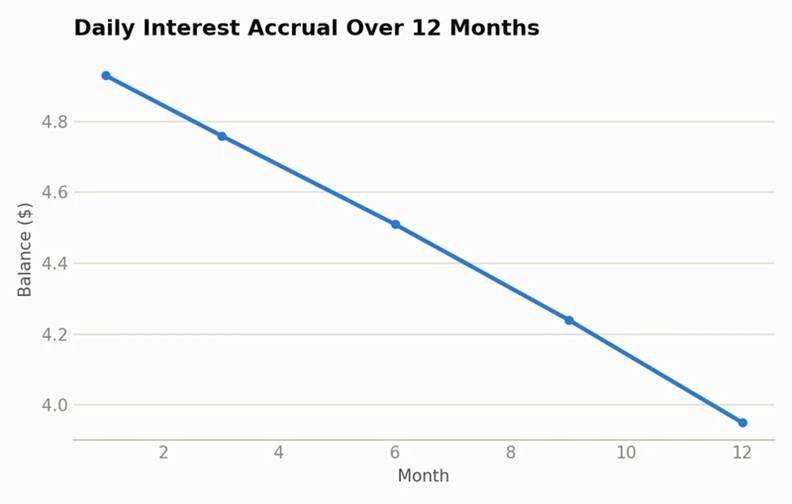
Line chart showing daily interest accrual declining slowly as principal is paid down over a year
The Bottom Line
Your student loan doesn’t wait until the due date to begin charging interest; instead, it adds a small amount of interest each day according to your current balance. By understanding how this process works, you can take two completely free actions: making your payment a few days earlier in each billing cycle, and paying any extra amounts earlier in the month rather than later. Neither of these options involves paying an additional dollar; they only require you to be mindful about when within your existing payment you make the payment.