 ZenPayoff is a 100% free tool. No hidden fees. No forced registration required.
Does the debt snowball method work for personal loans with high interest rates?
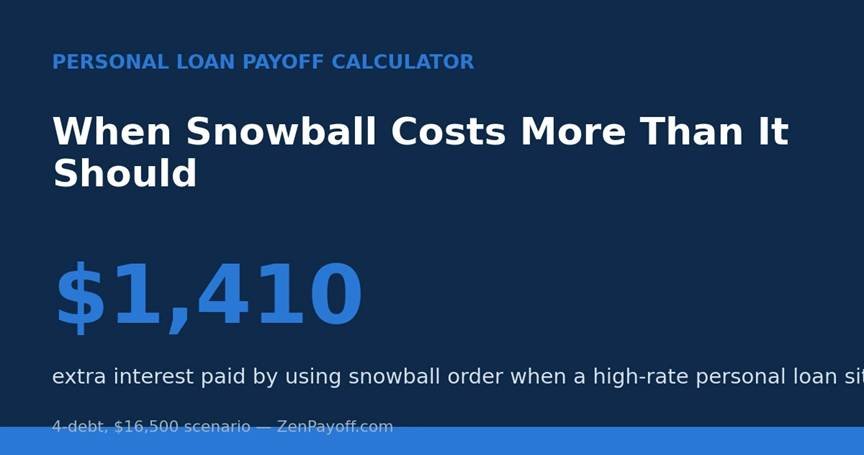
Chart showing the interest cost difference between snowball and avalanche when a high-interest personal loan is included
Does the debt snowball method work for personal loans with high interest rates?
The major psychological advantage of the debt snowball method, the decision to ignore interest rates, becomes its greatest financial flaw in one case: when a high-interest personal loan is in the middle of your debt list. This is when the usual advice comparing snowball and avalanche methods should be reconsidered.
Why Personal Loans Break the Usual Assumptions
Most comparisons between snowball and avalanche repayment assume credit cards have the highest interest rates, which is often true. But unsecured personal loans, especially from online lenders or taken by people with poor credit to consolidate debt, can have APRs from 25% to 36%, sometimes higher than the credit cards they replace. If the personal loan has a moderate balance—not the smallest or largest—the snowball method can leave it unpaid for a dangerously long time while smaller, lower-rate debts get priority.
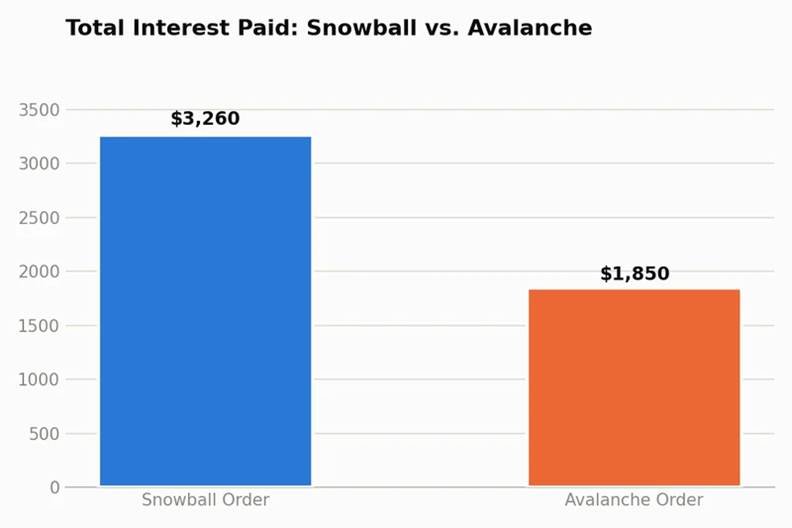
Bar chart comparing total interest charged between snowball and avalanche ordering when a high-interest personal loan is included
The Math: A 4-Debt, $16,500 Case Study
Consider this realistic mix:
- Store card: $900 at 18% APR
- Credit card: $3,600 at 22% APR
- Personal loan: $6,000 at 32% APR
- Auto loan: $6,000 at 7% APR
With $600/month available for extra payments:
- When dealing with the snowball method—prioritising the accounts with the smallest balances first: the store card, then the credit card, and then the personal and auto loans which have the same balance—the store card and the credit card are settled first, but the personal loan with an APR of 32% continues to accrue interest throughout the entire period, the total interest paid over the full repayment being about $3,260.
- In terms of avalanche method (with the highest APR coming first: personal loan → credit card → store card → auto loan), the personal loan is dealt with right away, which stops the accrual of interest much earlier—the total interest over the full repayment is about $1,850.
The difference—$1,410—is much greater than the interest difference in an ordinary comparison between the snowball and avalanche methods when using all credit cards, since the personal loan’s APR of 32% causes such damage each month that it is not given priority.
The Rule of Thumb I Recommend
Instead of giving up on the psychological advantages of the snowball method altogether, I suggest a simple adjustment for people who have a personal loan APR above about 24 to 25 percent: if any of your debts has an APR that is more than 8 to 10 points higher than your average rate, treat it as a mandatory exception in the avalanche method, no matter what position it holds in your list of balances. You should pay it at the same time—as indeed, possibly even before—your smallest snowball target, rather than waiting for your turn based simply on the size of the balance.
It maintains the incentive associated with clearing a small balance rapidly at the same time as stopping an unusually high-rate loan from quietly building up a substantially greater amount of interest.
How to Identify Whether Your Loan Qualifies as an Outlier
Instead of just looking at the interest rate quoted, you should check the APR on your loan since origination fees and add-on insurance products can cause the effective APR to be considerably higher than the advertised rate. In the case where the APR on your personal loan is only a few percentage points above that of your other debts, using the standard snowball method is acceptable. However, if the APR is significantly higher—especially if it’s above 25–28%—then the avalanche approach mentioned above should be applied.
Modeling the Trade-Off for Your Specific Debts
The $1,410 figure mentioned above applies to this particular case; the amounts you obtain will vary according to your actual balances and interest rates. By using our free debt payoff calculator, you’ll be able to compare a strict snowball approach with a snowball approach that includes an avalanche exception by entering your real debts and see the exact difference in interest before deciding on either method.
When Refinancing the Personal Loan Beats Either Method
If the APR on your personal loan is high simply because your credit history was poor when the loan was first obtained, it’s worth looking into whether your credit record has improved since that time — in which case a personal loan refinance or switching to a lower-rate consolidation loan could lower the 32% APR that we mentioned in our example to somewhere in the range of 12-15%, a change that would make a difference to the payoff order that makes sense. It’s important to consider this possibility before deciding on either a full snowball or a full avalanche approach, since a successful refinance could reduce the interest rate difference that originally caused the outlier to be a problem.
Tracking a Mixed-Method Plan
A combination method — that is, snowball ordering with a high-rate exception — is more difficult to keep track of by hand than a simple snowball or a pure avalanche approach, since it involves moving away from one straightforward rule. Those readers who use this type of mixed strategy often find it easier to useour credit card debt tracker, which enables you to mark certain debts as priority exceptions and which then automatically adjusts the complete payoff order whenever the balances change.
Common Mistakes When Personal Loans Are in the Mix
- Looking at the interest rate rather than the APR is misleading because although the rate advertised for a personal loan may seem reasonable, the actual APR—taking into account the fees—gives a different picture.
- It is true that, on average, personal loans have lower interest rates than credit cards, but this is by no means universal, particularly in the case of loans obtained with poor credit or via certain online lenders.
- Disregarding the loan altogether since it’s “not a credit card”; the calculations for paying off the debt don’t depend on the type of account that has the balance—only the APR and the balance are relevant.
- When refinancing it is important to carefully compare the new terms; although a refinanced loan might have a lower monthly payment this can be due to a longer term which will in fact increase the total interest charged even if the rate is lower—always check the total interest rather than just the monthly payment.
What the Wider Data Shows
The statistics on consumer credit provided by the Federal Reserve indicate that non-revolving consumer credit—this covering a large number of personal loans—has grown together with credit card balances, which means that households with a mix of debts such as the one in this example are becoming more common rather than being a rare occurrence. Experian’s research into personal loan interest rates also points out the wide variation in APRs depending on the credit profile at the time the loan is originated, explaining why it is more important to check your actual rate than to assume that personal loans are always cheaper than credit cards.
A Middle-Ground Approach Worth Considering
For those who appreciate the snowball method’s structure but are worried about the mathematical risk involved in taking out a high-rate loan, there’s a compromise: divide your extra payment between the smallest snowball loan and the high-rate loan rather than putting all of it towards just one. In the example mentioned, allocating 70% of the $600 extra payment to the personal loan and 30% to the smallest snowball target still achieves a small benefit within a few months while substantially reducing the interest that accumulates on the loan with a 32% APR. Although this isn’t the most mathematically efficient option when compared to a strict avalanche approach, it manages to gain most of the interest savings while still keeping some of the motivational aspects of the snowball method.
Why This Distinction Rarely Shows Up in General Advice
The typical articles aimed at the general public when discussing the debt snowball and debt avalanche methods generally suppose that all your debts are credit card debts, since in such cases the APRs are usually quite close to one another—often differing by only 5 to 10 points. Personal loans, particularly those obtained for the purpose of debt consolidation and having subprime terms, contradict this assumption by introducing a greater spread, something that the simple recommendation to ‘just choose snowball or avalanche’ fails to take into account. The step that most people omit is to check their actual APRs before deciding on a method rather than assuming that the general advice applies in all cases.
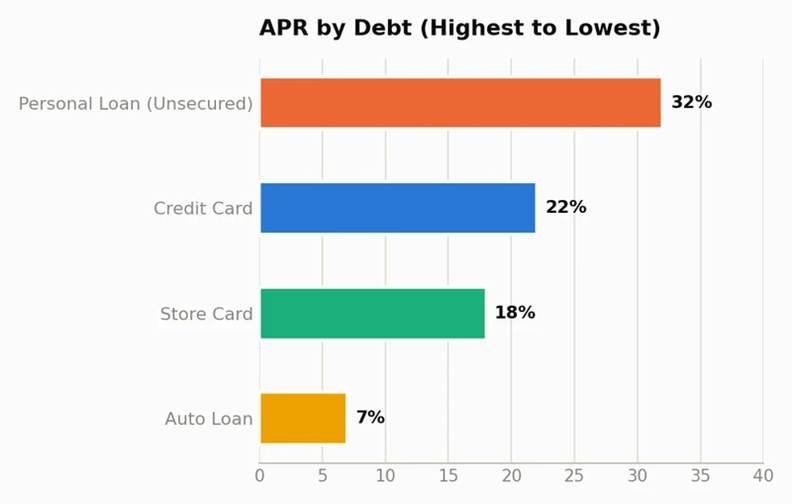
Horizontal bar chart ranking four debts by APR including a high-interest personal loan
The Bottom Line
The debt snowball’s smallest-balance-first rule works well in most situations. Still, a high-interest personal loan can break the assumption that ignoring APR costs only a modest amount of extra interest. When a loan’s rate is meaningfully higher than your other debts, treating it as a mandatory exception — prioritizing it regardless of balance size — preserves the cognitive benefits of the snowball method while steering clear of a costly blind spot in the math.